New for 2012!

I’m bringing in 2012 with two new books and the cover story in Fortean Times in what should prove to be an interesting year.

If the doomsayers are correct we should expect the coming year to bring (in no particular order) ‘the end of the Mayan calendar’, shifts in the Earth’s magnetic pole, Eurogeddon and an alien invasion at the opening of the Olympics.

But while you prepare for Armageddon check out the lead story in Fortean Times 284, published on 5 January, for some light relief. In my feature ‘Scared to Death’ I investigate a fatal encounter with a ghost in 19th century Sheffield and look at other Victorian examples of alleged ‘death by supernatural causes’.  In the same issue Andy Roberts and I unearth a new case from the UFO archives in which a Yorkshire police officer was visited by the mysterious ‘Men in Black’.

Also new for 2012 are two chapters in a ‘history of Media-Driven Panics and Hoaxes’ published in the USA by McFarland & Co. That’s the subtitle of The Martians Have Landed! the latest from the sceptical pen of Robert Bartholomew and Ben Radford. This book features case studies of three dozen media-driven scares from the 17th to the 21stcentury, including some notorious hoaxes perpetrated by newspapers, radio, TV and via cyberspace.  There are historical examples such as the Orson Welles Martian broadcast and accounts of more recent Satanic cult scares and Pokemon panics. The book highlights the serious impact sensational media coverage of hoaxes and false belief-legends can have on our lives.

The Martians Have Landed! - by Robert Bartholomew and Ben Radford, published on 30 December

My contribution to the book concentrates on media-driven urban legends, including miraculous photographs of Jesus and the infamous ‘curse of the crying boy’ painting, spawned by News International’s tabloid The Sun in 1985. Co-author Bartholomew taught sociology at universities in Australia and is a former journalist, while Ben Radford is deputy editor of The Skeptical Inquirer and a prolific author of numerous articles on a variety of topics including urban legends, critical thinking and media literacy.

2012 will also see the publication of a new edition of my book The UFO Files – The Inside Story of Real Life Sightings. Published in the summer of 2012 by Bloomsbury, who acquired The National Archives list last year, the expanded version will mark the release of the last remaining MoD UFO files. The book first appeared at the beginning of the disclosure programme four years ago and the second edition will update the story and include much new material.  Watch this space for more details.

Since I began work as consultant to The National Archives UFO project in 2008 media coverage of the ongoing file releases has reached an estimated print/online readership of 25 million people across the world. If those figures were not amazing enough, the TNA’s UFO website has now been visited over three million times by curious people from 160 different countries (source: TNA).

Public interest in ‘Britain’s X-Files’ appears to be undiminished and during the coming year it may yet break more records. In the meantime, look out for me discussing the UFO files on the BBC TV programmes Stargazing Live (presented by Professor Brian Cox and Dara O’Briain) and The One Show in January.

Ignore the doomsayers and have a happy new year!

Posted in Uncategorized | Tagged , , , , , , , , , , , , , , , , , , | Leave a comment

Roswell? It’s all balloony, says RAF

RAF's Cosford's Cold War display, featuring the 'Roswell incident'

First the White House formally denied it was hiding any secret evidence of visits from extra-terrestrials.

Now it seems the Royal Air Force has made it known that one of UFOlogy’s key legends – that a flying saucer crashed at Roswell, New Mexico, in 1947 – was a Cold War military experiment after all.

This revelation came not from a Top Secret document, but in an educational display at the RAF’s Cold War museum at RAF Cosford, near Wolverhampton.

On a recent visit to the museum, which features all three of Britain’s surviving V-bomber force, I came across a familiar photograph on a display covering aerial espionage during the early part of the Cold War.

It was taken at Fort Worth, Texas, on 8 July 1947 and shows Major Jesse Marcel holding pieces of debris recovered from a ranch in the New Mexico desert. This was less than 24 hours after the Army Air Force announced it had recovered the wreckage of a “crashed flying saucer”, a statement quickly retracted and replaced with the cover story that it was a weather balloon.

The RAF caption agrees with the USAF conclusion that the wreckage was from a balloon after all, but not an ordinary balloon:

“This was an unsuccessful experiment to use balloons carrying instruments to detect Soviet nuclear tests which led to claims of a spaceship having been found.”

It is evident the British military played a role in these and later ‘experiments’ as the display also features images of the giant helium-filled balloons used for more extensive espionage operations targeting Soviet facilities during the 1950s.

The joint USAF/RAF Project Moby Dick employed balloons as tall as a 20-storey building, carrying gondolas packed with photographic equipment. The cameras took one photograph every six minutes in strips 65 km wide by 3100 km long. This operation, like that which led to the Roswell incident, was classified.

Moby Dick was abandoned in 1957 without significant success; by that point balloons had been replaced by Black Project aircraft such as the Lockheed U2.

Such is the level of distrust attached to all official statements on the subject of UFOs and Roswell that the RAF’s conclusion will be treated as just another example of the cosmic Watergate to conceal ‘the truth.’

In November the US Government responded to online petitions calling on the Obama administration to disclose evidence of “an extraterrestrial presence here on Earth.”  As neither the US government or the scientific community has any such evidence, whatever it said was unlikely to make any impression upon the faith of those who wish to believe otherwise. Or, in the words of a British MoD official who briefed on a similar campaign in 1958:

“As it is not possible to release official information about something which does not exist, it is difficult to satisfy those with preconceived ideas to the contrary.” (TNA DEFE 31/118).

One final irony is that RAF Cosford itself now has a secure place in the UFO mythology, thanks to a classic “sighting” of lights in the sky made by military personnel at the base in the early hours of  31 March 1993. The “Cosford incident” now rivals the Roswell incident in the lists of classic UFO cases cited by some as the best evidence of ET visitations, in the UK at least.

As with Roswell, there is a perfectly good explanation for the lights seen from RAF Cosford – and once again, the Russians are in the frame. They were caused by the burning rocket body of a Russian Cosmos satellite that re-entered Earth’s atmosphere over the British Isles at the precise date and time as the “UFO sighting.”

But, to recycle a favourite phrase coined by a believer in UFOs: “you can’t tell the people.”

Posted in Uncategorized | Tagged , , , , , | 1 Comment

Scared to Death

The Fortean Times Unconvention 2011 – billed as the world’s weirdest weekend – returns to London in November.

I’m on the bill for both days (12 and 13 November): on the Saturday I will be speaking about my research into a case of alleged ‘death by supernatural causes’: the death from fright of Sheffield woman Hannah Rallison in 1855, the result – so it was claimed at her inquest – of a close encounter with a ghostly woman in white.

An early image of Spring-heeled Jack, the Terror of London, published in 1838. Jack has been blamed for a number of deaths from 'fright' (Credit: Mike Dash)

The fatal experience will form the centre of my new book project on Victorian ghost stories, appropriately titled Scared To Death. On the Sunday, I’ll be sharing the stage with long-time sidekick Andy Roberts for a talk on cursed stones. This will examine cases where people have linked hauntings and other supernatural experiences with cult stone artefacts such as Celtic stone heads and other stone objects, such as the Hexham Heads and the Tigh nam Bodach shrine in Scotland.

In the meantime, diary columnist Colin Drury has published a pre-Halloween interview with me in my old paper, The Sheffield Star, on my research into the Rallison story. You can follow the link here or read on:

“There are few people more sceptical of the paranormal than media personnel, although they know it will always make a good story,” claims spookologist Andy Owens in his new book, Yorkshire Stories of the Paranormal. And he’s absolutely right…for while The Diary has never yet been told a ghost stories he believes, it’s certainly always worth hearing them, if only for a giggle. It is thus, in that spirit – and to celebrate Fright Night on Sunday and Halloween on Monday – here presented are a trio of South Yorkshire’s most intriguing tales of the unexplained…

Scared to Death on Campo Lane…The background:

There are certain irrefutable facts about the death of Sheffield Mormon Hannah Rallison in Campo Lane, in 1855. She collapsed in front of several people after entering a cellar said to be haunted. She claimed, as she drifted in and out of consciousness, she had seen a ghost. And experts at an inquest could not find a rational explanation for the healthy 48-year-old’s sudden demise.

“This is one of the most fascinating mysteries I’ve come across,” says David Clarke, former Star journalist, author and all-round expert in the unexplained. “What’s intriguing is that, unlike many of these stories, it is all document in newspaper reports and the inquest – but still no one really knows what happened.”

What we do know is that the Campo Lane cellar – below the home of fellow Mormon John Favell – was said to be haunted after John himself claimed he spotted an old woman there. As neighbours gathered to investigate on February 24, Hannah temporarily entered the cellar alone. There, in front of several witnesses, she was seized by terror, shrieked she had seen a ghost and collapsed. She died in her South Street home the next day.

“This was all recorded as fact,” says David, who has researched the incident for an up coming book on Victorian mysteries. “It fascinated so many people it actually ended up being reported in several national newspapers at the time.”

Research by David shows that within a couple of weeks The Sheffield Independent claimed to have found an explanation. “We have been informed,” it said, “that some of the alleged appearances resulted from the operations of a magic lantern by the occupiers of adjacent premises, who knew that Favell and his family were Mormonites, and determined to have a lark at their expense.”

David asks anyone with possible information about Hannah Rallison or the Favells to email furnival.news@googlemail.co.uk

The up-coming book mentioned by Colin is my book project Scared To Death: Victorian Ghost Stories from Yorkshire. The book will include the fruits of 20 years research into the folklore of the county and primary accounts of hauntings sourced from 19th century newspapers.

Posted in Uncategorized | Tagged , , , , , , , , , , , | 1 Comment

Watch Out – there’s a flying pig about!

Pink Floyd’s giant inflatable flying pig has appeared once again above the London skyline to celebrate the reissue of the band’s back catalogue including the classic album The Dark Side of the Moon.

Pigs on the Wing (credit: Sky News)

The 30 foot long porker is a replica of the original stage prop that featured on the sleeve of the iconic Animals album, floating above the towers of the Battersea Power Station.  The pig was constructed in Germany by the same company that made the Zeppelins. When it was launched in December 1976 a hired marksman was on hand, armed with a rifle loaded with dum-dum bullets. But as the band and assembled photographers watched in horror, one of the guiding lines broke and the pig floated off into the sky.

This triggered off one of the strangest UFO flaps on record, courtesy of a band who cut their teeth in London’s underground UFO club during the sixties. The first sighting came from a pilot who reported having spotted a flying pig on landing at Heathrow airport. According to some reports, he was given a breath test before his sighting was taken seriously. Minutes later the pig was spotted by a police helicopter which followed it to 5,000 feet above the capital.  People in Croydon and Brixton were also watching a strange object in the sky and called the MoD to file UFO reports.

The Civil Aviation Authority put out an alert to all pilots that “a 40 foot long, pink flying pig” was on the loose over the city and it was last seen on radar near Chatham in Kent at a height of 18,000 feet, heading east towards Germany (was it a homing pig?).

Hidden within the thousands of UFO files collected by the Ministry of Defence and held by The National Archives in Kew is one curious folder titled “UFOs – 3 December 1976: Watch Out, there’s a flying pig about.”

But this UFO quickly became an Identified Flying Object. The pig came to earth in a field at Chatham in Kent and the rest is history. Pigs might fly….

Posted in Uncategorized | Tagged , , , , , , , , | Leave a comment

The Inconvenient Truth is Out There…

The truth about the British Government’s interest in UFOs has been released by The National Archives.

In what I believe to be the most important revelation so far in the British disclosure programme, the MoD’s Defence Intelligence Staff admit that “lack of funds and higher priorities” had prevented any detailed study of the thousands of reports they had received since the end of the Second World War.

The frank admission is contained in a formerly secret memo dated July 1995 and written by the UFO desk officer at DI55, the branch of the DIS responsible for the assessment of UFO reports for defence threat.  The officer – a RAF Wing Commander - concludes the lid had already been blown on secrecy surrounding defence intelligence interest in UFOs by a series of media revelations. But he said the public perception of DI55 as “defenders of the Earth from the alien menace” was “light years from the truth”. And he told his opposite number on the MoD’s public UFO desk that few people would believe the “embarrassing truth…that lack of funds and higher priorities had prevented a proper study of UFO sightings.”

Another formerly secret document produced by the head of Sec(AS), the MoD’s UFO desk, in the same year underlines the MoD’s lack of  interest in UFOs. The official admits that no research had ever been done on UFOs either by DI55 “or anyone else” and adds:

“We don’t do research into the phenomena; we haven’t done any; we only would if there were some good reason for doing so – ie. evidence of a threat.”

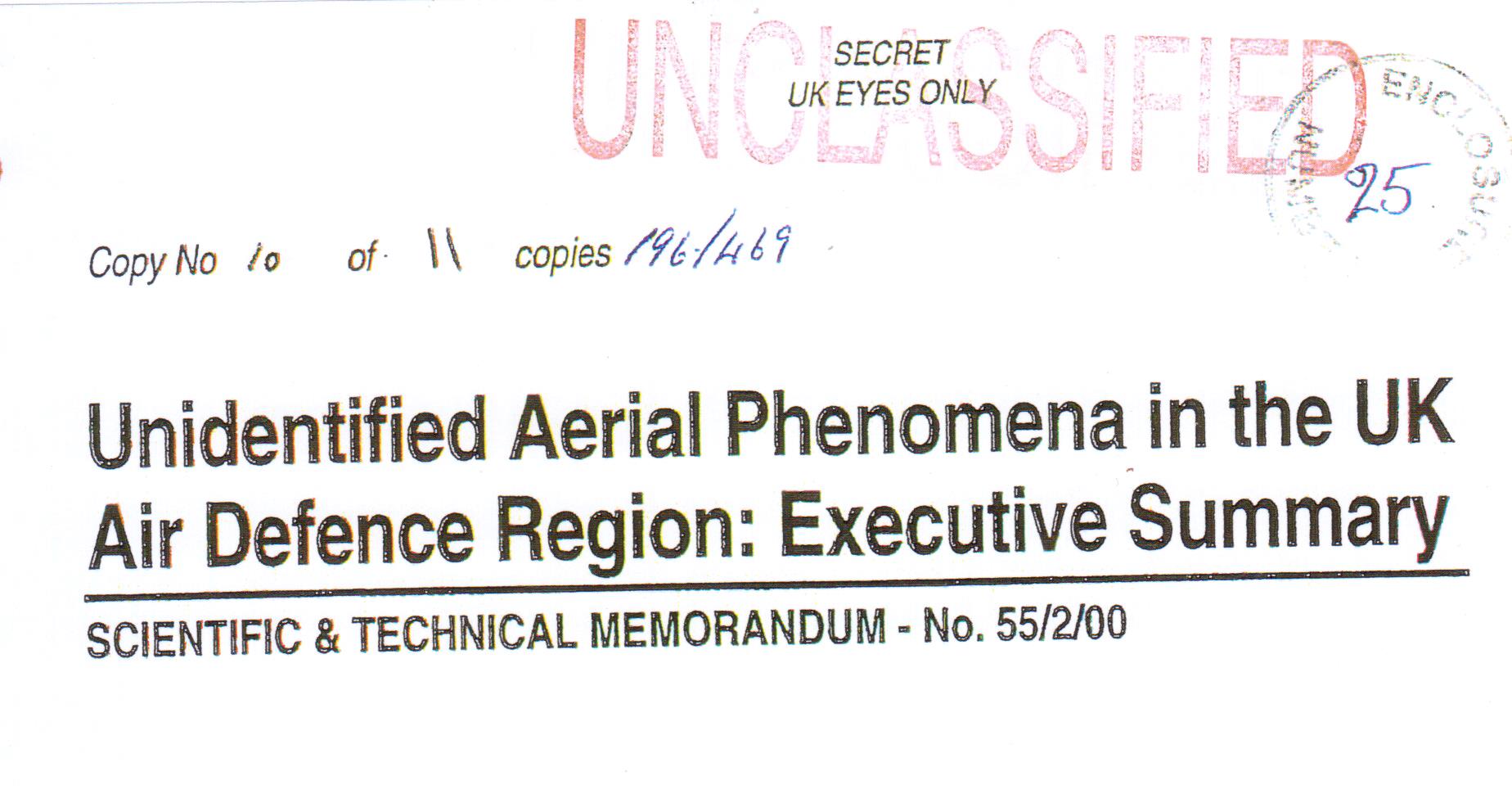
These embarrassing revelations led MoD to approve a DI55 plan for a retired intelligence officer to produce a report on “Unidentified Aerial Phenomena”  (code-named Condign) that was based upon a computerised study of UFO data. Work on the study began in 1996 and a copy of this report was released under FOIA ten years later.

The DI55 smoking gun is just one of 8,600 pages of material within 34 MoD UFO files opened on Thursday 11 August by Britain’s National Archives. Read my detailed summary of the contents here. You can listen to my interview with Sanchia Berg on BBC Radio 4 Today programme here and read a bylined feature here.

This is the eighth and possibly penultimate release of files in a rolling programme that began in 2008. Visitors to the UFO pages can download the files free of charge for the first month. By Friday 12 August the site had received more than half a million visitors and 125,000 downloads.

Other highlights include details of MoD’s continuing interest in photographs depicting “unidentified aerial phenomena”. The files include:

  • Image analysis experts working for British intelligence were asked to examine a transparency that clearly shows an “elliptical object” in the sky above Retford in Nottinghamshire – click here for details (DEFE 24/2060/1)

    UFO over Retford 2004? (Copyright A. Birch)

  • The remarkable first-hand testimony of retired RAF Fighter Controller Freddie Wimbledon on the role he played in the famous 1956 UFO incident at RAF Lakenheath in Suffolk. (DEFE 24/2031/1).
  • The truth about a bogus story published by two tabloid newspapers in 1998 that claimed the early warning station, RAF Fylingdales, had tracked a UFO “as big as a battleship” moving at fantastic speeds (DEFE 24/2047/1).
  • Papers on the unexplained sighting of two cigar-shaped UFOs by pilot Ray Bowyer and passengers on a Trislander aircraft near Alderney, in the Channel Islands, in April 2007 (DEFE 24/2081/1)
  • More than 70 pages of censored documents containing the MoD’s internal discussions surrounding the clearance of Nick Pope’s book Open Skies Closed Minds, published in 1996 (DEFE 24/2091/1).

All 34 files can be downloaded from The National Archives UFO page, along with a podcast I have prepared with Pennine Productions.

The release was covered extensively by print and broadcast media. Here are just a few of examples of the coverage on 11/12 August:

New York Times: ‘The Truth is Out There: UK X-Files Put Online’

British Forces News Worldwide (Top Story): ‘Secret MoD files containing UFO sightings released’ [link to broadcast footage]

BBC Radio 4 Today: ‘The Truth Isn’t Out There’; interview with Sanchia Berg on Today programme, 11 August .

BBC News: ‘UFO Sightings were not investigated’ [link to broadcast footage]

BBC News Online: ‘Ministry of Defence files on UFO sightings released’.

Metro: ‘UFO sightings of Mork and Mindy over East Dulwich detailed by MoD’

Daily Mail online: “Mork and Mindy came to visit.’

Daily Mirror: “UFO sightings revealed”

Daily Star: ‘Aliens spotted by the sober at Glastonbury’

Daily Telegraph: ‘UFO files’

Copyright David Clarke 2011

Posted in Uncategorized | Tagged , , , , , , , | 4 Comments

If you go down to the woods (again)

The Rendlesham forest UFO mystery is back in the headlines, after the Sunday Telegraph published a summary of my exclusive interview with the former Bentwaters Base Commander, Ted Conrad.

Col Conrad, now retired to his native Texas, has broken a quarter of a century of silence to reveal details of his investigation of the “unexplained lights” reported by airmen in the forest, outside RAF Woodbridge, Suffolk, in 1980.

Conrad claims his investigation was the only official inquiry conducted into the strange sightings apart from the RAF’s lack-lustre checks on air defence radars two weeks after the events. The American inquiry concluded there was no hard evidence that would even justify a report to USAFE headquarters at Ramstein. Instead, Conrad’s deputy Charles Halt was instructed to write a report for the British Ministry of Defence. This was a clever move that effectively consigned it to oblivion.

Halt’s report became the famous “Halt memo”, a copy of which was obtained under the US Freedom of Information Act in 1983. It later appeared as a front-page splash ‘UFO Lands in Suffolk’ in The News of the World, at that time edited by Derek Jameson.

As Jasper Copping’s article in the Sunday Telegraph explains, Conrad says the story told by some of his men, including Halt, has been embellished from the original account of lights in the forest into a gigantic conspiracy by the US and UK to hide evidence of ET interest in our nuclear weapons. Conrad’s view is shared by a number of his colleagues who have been reluctant to speak on the record. His successor as Base Commander, Col Sam Morgan, also looked into the story and concluded it was “just a bunch of guys screwing around in the woods.”

The irony is this wasn’t just an ordinary “bunch of guys”. It was a group of airmen tasked with the perimeter security of a nuclear-armed NATO airbase.

Nevertheless, when I questioned Conrad, he remained open minded about possible explanations for the incident. But he felt the chances of a landing by extra-terrestrials was about as likely as a covert visit from the Russians.  As the British MoD pointed out, if this was a secret visit, why announce it with brilliant lights?

Col Conrad also mentioned the possibility of an elaborate hoax, but I think that is equally unlikely. Speculation has been rife that the events were a cover for some secret test involving hi-tech weaponry, the crash of an experimental aircraft or an accident involving nuclear missiles. The plain facts remain that after 30 years not a single piece of hard evidence has surfaced to support any of these wild theories.

To quote Sherlock Holmes, “when you have eliminated the impossible what remains, however improbable, must be the truth.”

The answer must therefore be found in what the British intelligence UFO study Condign described as “natural but not unusual phenomena and natural but relatively rare and not completely understood phenomena”. What we now know is that Col Conrad and his men saw no lights in the sky, even whilst Halt’s team were engaged on his own private expedition into the forest outside the base perimeter. Furthermore, despite claims to the contrary, checks on air defence radars at RAF Watton, whilst the sightings were ongoing, found no trace of an unidentified flying object.

The conclusion has to be that whatever Halt and his men saw, it was only visible in the immediate vicinity of the forest. Furthermore the UFOs were invisible to radar and to Halt’s boss at RAF Bentwaters, who was watching the sky and in direct contact with his deputy by radio. Remember this was the point at which Halt has subsequently claimed the aliens began shining beams onto the weapons storage area at the twin base complex. Col Conrad was outside his quarters at RAF Bentwaters with his wife and other senior officers. According to their story, despite a clear, cloudless night with a 360 degree field of view, they saw nothing.

Logic dictates that we must be dealing with either some form of transient natural phenomena, such as a mirage or will o’the wisp, or a complex mis-perception of the Orfordness Lighthouse and/or other light sources. The explanation favoured by astronomer Ian Ridpath is, in my view, the correct one. I’m reminded of what Suffolk police inspector Mike Topliss told author Georgina Bruni:

“The immediate area [is] swept by powerful light beams from a landing beacon at RAF Bentwaters and the Orfordness lighthouse. I know from personal experience that at night, in certain weather and cloud conditions, these beams were very pronounced and certainly caused visual effects.”

Similar optical phenomena caused a series of shipwrecks on the Durham coastline of northeastern England during the 1860s (see my article here).

It is unecessary to invoke aliens, time travellers, extra-dimensional demons or fantasies from the world of James Bond to explain the Rendlesham UFOs. When I was approached by Jasper Copping for a position statement on Rendlesham, I said I didn’t think anyone, least of all Col Conrad, doubts that Halt and his men saw something unusual in the woods. They had an extraordinary experience. And that experience remains extraordinary, regardless of whether ultimately it was caused by the Orfordness lighthouse or an alien spacecraft.

The Rendlesham mystery (and it remains a human mystery, even if exotic phenomena were not involved) is a textbook example of a contemporary legend, based upon real extraordinary experiences, for these reasons:

  • The story has grown, in the re-telling, from Halt’s straightforward, if bizarre, account of “unexplained lights” into a complex narrative involving missing time, conspiracies by secret elites and messages from time travellers.
  • The accounts by eye-witnesses confirm my view that whatever the source of individual experiences, the way we report and interpret those experiences creates the basis for the UFO myth perpetuated by the media (which is the basis of the Psycho Social Hypothesis).
  • The scene of the ‘encounter’ in Rendlesham Forest has become a pilgrimage site for those who want to believe.
  • Like Roswell, the Rendlesham legend has developed what Tim Printy calls its own “holy relics and prophets.”

What continues to fascinate me about this living legend is that here we had, at the height of the Cold War, airmen we relied upon to defend us caught up in what appears to resemble a real-life version of the film, The Blair Witch Project.  Effectively, for a few hours they were away with the fairies. Forests have always been mysterious places that provide access to the Otherworld. The fact this happened in the present day makes no difference.

The Rendlesham forest incident is folklore in the making.

Copyright David Clarke 2011

Posted in Uncategorized | Tagged , , , , , , , , , , , , | 1 Comment

Hilary Evans 1929-2011

Archivist, author, intellectual researcher into the source of a range of Fortean phenomena and an eloquent exponent of the Psycho Social Hypothesis.

Hilary Evans (Clas Svahn)

Hilary Evans was all of these things and more. Above all, he was a real gentleman and a friend. I’m saddened to hear of his passing just a year after the death of his wife Mary (read obituary here), who co-founded the Mary Evans Picture Library with Hilary in 1964.  He also helped to co-found ASSAP, the Association for the Study of Anomalous Phenomena, in 1981. He was a towering intellectual presence in a field bedevilled by sensationalism and controversy.  The loss of his moderating influence will leave a void that cannot be easily filled. Hilary passionately believed that we could learn from the study of extraordinary experiences, whatever their ultimate source.

But he will also be remembered for his books, which were a key guiding influence for me and other young researchers from the 1970s onwards. Titles such as Visions – Apparitions – Alien Visitors, Gods – Spirits – Cosmic Guardians, Seeing Ghosts and Other Worlds will remain standard introductions to the interpretation of UFO encounters and other extraordinary phenomena as culturally shaped visionary experiences (the Psycho Social Hypothesis).

Hilary’s work will also survive in the care of his friends at UFO Sweden, and the wonderful AFU Archive. Since 2003 the volunteer staff at AFU have slowly become the curators of his vast collection of books, periodicals and papers. More than five tons of his collection has been shipped from MEPL’s HQ in Lewisham, south London, to the Archive near Stockholm, during the past decade, where it will be preserved for use by future generations of Fortean researchers. I visited the AFU collection in 2006 and marvelled at what the organisation modestly describe as “one of the most complete repositories of UFO data and UFO folklore in the world.” I can testify to the care and dedication of its staff to the preservation of archive material that no other organisation appears to value, at least not at the present time. Hilary’s legacy is safe in their hands.

A fine tribute, penned by UFO Sweden’s Clas Svahn, can be found here. You can also read more about Hilary Evan’s life here.

Rest in peace, Hilary.

Posted in Uncategorized | Tagged , , , , , , , , | 1 Comment

Aliens in the imagination

What explains our continuing fascination with aliens?

Mark Pilkington has a narrow escape as a flying saucer crashes into bookshelves at the British Library, Out of this World exhibition

Wandering (or was it wondering) around the British Library’s excellent Out of this World exhibition, I was struck by the long and deep debt the current cultural obsession with UFOs and ET visitors owes to the imagination of science fiction writers. Virtually all the key themes that occur in the post-1950 UFO literature – from disappearing planes to alien abduction and mind-control – were anticipated decades before the flying saucer age, both in visual media and in novels and short stories published by magazines such as Amazing Stories (founded in 1926 by Hugo Gernsback).

To give just one example from the BL exhibition, two short stories published by Wonder Stories eighty years ago – Clark Ashton Smith’s ‘The Dimension of Chance’ (1932) and Jack Williamson’s ‘Through the Purple Cloud’ (1931) – feature the motif of disappearing planes. In Williamson’s story the purple cloud is a portal to another dimension. It appears from nowhere and swallows the plane and its passengers, transporting them to a strange alien world. Post-WW2 the link between UFO sightings and the mysterious disappearance of aircraft and ships re-emerged in a ‘non fiction’ context in Harold Wilkins’s Flying Saucers on the Attack (1954).  By 1965 there were enough real examples for Vincent Gaddis to write Invisible Horizons, the book that launched the the ‘mystery’ of the Bermuda Triangle. Subsequently, self-declared UFOlogist Steven Spielberg used the disappearance of Flight 19 as the inspiration for the opening scene in his film Close Encounters of the Third Kind (1978).

'Through the Purple Cloud', 1931 (credit: E-fanzines.com)

Included in the ranks of early SF writers were key figures who helped to lay the foundations for the UFO myth – names such as Ray Palmer, Desmond Leslie and Brinsley le Poer Trench (Lord Clancarty), who wrote SF short stories before turning his attention to flying saucers from 1954.

Yet despite the long exchange of ideas and personnel, there remains today little or no intellectual discourse between the key figures in science fiction and UFOlogy. This was evident at the British Library talk Aliens in the Imagination, where I presented an overview of the evolution of aliens in popular culture, from Gerald Heard’s Martian bees to Whitley Strieber’s ‘visitors’. My talk kicked off an evening of presentations by a panel of speakers drawn from science and sci-fi.  Chaired by Alex Fitch, the evening featured an entertaining double-act from scientists Jack Cohen and Ian Stewart, authors of What Does a Martian Look Like?, a how-I-did it guide to CGI alien-creation by Gareth Edwards, director of the alien road movie Monsters (2010) and – to finish off – there was a reading from British sci-fi writer and winner of the Arthur C. Clarke Award, Gwyneth Jones

Sandwiched between my presentation and the Cohen & Stewart show was Mark Pilkington’s talk on the use of the UFO/alien meme by governments and intelligence agencies. This complemented the “aliens in popular culture” theme nicely, but collectively only served to emphasise the impression that, when it comes to science fiction and science ‘fact’, it’s a case of ‘never the twain shall meet’.

Unfortunately, as the talks overran the time allowed, there was no opportunity for the speakers to discuss this dichotomy among themselves, or take questions from the audience, that would have allowed us to develop these issues. This elephant in the room was also noted in a review posted on Scholars and Rogues, where wufnik writes that: “Aliens have been a recurring themes in the science fiction of the post-war decades, and like other memes, often represent the political and cultural world that surrounds their literary or celluloid creation”.

In other words, our changing ideas of alien appearance, origin and motives reflect contemporary preoccupations and obsessions. Our imagined visitors are, in effect, us – as evident from one of the highlights of the exhibition, H.G. Wells’s short story, “Man of the Year Million”. Writing in 1892, the master of science fiction stories speculated that mankind was slowly losing ape-like traits and ultimately would evolve into a humanoid form with “a larger brain and a slighter body”. In effect creatures very much like the “greys” depicted in today’s UFO and alien abduction literature.

"As Ruskin has said somewhere, apropos of Darwin, it is not what man has been, but what he will be, that should interest us" H.G. Wells, Man of the Year Million 1892 (Credit: Technoccult.net)

If you are visiting central London before 25 September and have any interest in these subjects, make the free Out of This World exhibition top of your things to do. The displays are broken into thought-provoking themes that include Alien Worlds, Parallel Worlds, Virtual Worlds and – finally – the End of the World. The last display brings together images of apocalypse, alien invasion and future dystopias imagined by fiction writers.

For information on the events programme and opening hours, visit the British Library website here.  The exhibition is complemented by Mike Ashley’s wonderful illustrated book Out of this World: Science Fiction but not as you know it (British Library, 2011) available in hardback and paperback from the exhibition shop. The book gives a comprehensive overview of how science fiction writers have responded to the impact of science, technology and socio-political change from the earliest times to the present day, with illustrations drawn from the British Library’s collection of first-edition books and magazines.

Posted in Uncategorized | Tagged , , , , , , , , , , , , , , , , , | 3 Comments

UFOs and the Vietnam War

Just occasionally we learn about a genuinely baffling UFO incident from a reliable primary source, such as a  military memoir or pilot’s logbook. One such gem was discovered hiding in a collection of journals covering daily events during the Vietnam War by an archivist working for the US National Archives.

Archivist and blogger Joe Gillette describes an 1969 entry in the daily journal of the 23 Infantry Division’s Chu Lai Defence Command as more resembling “an episode of the X-Files than a war movie.”

The command defended territory in the Chu Lai Defense Sector on the Vietnamese coast about 40 miles southeast of Da Nang. A network of observation towers ringed the base, with personnel tasked to report any unusual or threatening activity. One such entry, from the base journal, logged at 1.52 am on 6 January 1969 reads:

“…Twr 72 rpts object flying into their area about 700, infront [sic] of them, AZ 310 [degrees]. Object came in slow over the ASP & landed. It has a glowing light. It is about 15-20 ft across. It is shaped like a big egg. Control twr rpts their radar did not pick anything up. Object also does not seem to have any sound to it when it moves….”

According to Gillette, the only follow-up action taken on this remarkable report was notification of the duty officer and no mention is made of it in subsequent journal entries. Those looking for evidence of a cover-up will no doubt find significance in the fact that journals for the next two days, 7 & 8 January, are missing. But past experience has shown that “missing files” are often only significant when seen in hindsight (the military regularly lose bits of paper, as everyone else does).

The apparent lack of interest in or alarm about this sighting is equally familiar. Senior USAF officers who dealt with the sightings of “unusual lights” at RAF Woodbridge in Suffolk decided not to refer them up the chain of command for reasons that may appear suspicious today. Nevertheless, at the time this course of inaction appeared perfectly justified to the base commander (no hard evidence).

In the Da Nang case Joe Gillette suggests a number of conventional explanations for the incident, but dismisses them as unlikely. These include tracer rounds or flares, but these don’t float to the ground or appear egg-shaped. He also raises drug use by soldiers which, oddly enough, was also raised – and dismissed – as a possible factor in the Rendlesham incidents.

“Drug use by soldiers, particularly in 1969, was a known problem in Vietnam,” Gillette writes. “But two or more soldiers typically manned these towers. Assuming this was a drug-induced vision, it’s difficult to imagine they each experienced the same hallucination, although if they were observing something they could not readily identify, one might have convinced the others they were seeing a UFO.” He adds:

“Boredom too could have resulted in a bout of creative storytelling, but if discovered, the soldiers risked disciplinary action. So while conventional explanations exist for both the sighting and the report, nothing in the journals tell us which of those might have been at work.”

So what was it?  Could it have been some form of experimental drone being tested by the CIA or the Soviets? Or, more likely, was it a type of light phenomena described in the West as a “spook light” or “Jack o’Lantern”?  We will never know, but this – in my view – is another example of a Unidentified Aerial Phenomena or UAP, rather than a flying object.

Posted in Uncategorized | Tagged , , , , | Leave a comment

Only joking folks!

Great significance is often placed upon ET-related utterances from world leaders by those promoting ‘disclosure’ of UFO secrets. The former US President Ronald Reagan was well-known for having what one of his aides called an obsession with “little green men”, including a story about his own sighting from a plane in 1974. At the height of the Cold War he even startled his aides when, at a meeting with Soviet president Gorbachev, he suggested the two super-powers would cooperate if Earth was ever invaded by aliens.

Spielberg meets the Reagans (source: Ronald Reagan library)

Another persistent rumour was that after a special screening of ET: The Extra Terrestrial at the White House in 1982, Reagan turned to film-maker Steven Spielberg and “started talking about how close to reality it was” before being quickly ushered out of the room. Was Reagan about to spill the beans or was he simply having some fun?

A recent revelation by Steven Spielberg, interviewed for film website Ain’t it Cool in June, suggests that Reagan’s sense of humour was more nuanced than suspected. According to Spielberg, after the screening Reagan stood up and looking around at the guests, that included astronauts and judges, said: “I want to thank you for bringing ET to the White House, we really enjoyed your movie”. Then, completely deadpan, he added: “And there are a number of people in this room who know that everything on that screen is absolutely true.”

But rather than being quickly ushered out, the whole room erupted into laughter. The guests recognised this was a joke and this was confirmed when the President pulled Spielberg aside for a private chat. He recalls: “I don’t think he let something slip there, no…because I’m a bit of a UFOlogist I was hoping there was something more to the joke than met my eye [but] I’m sorry to say I think he was simply trying to tell a joke.” But why let the facts get in the way of a good story?

Posted in Uncategorized | Tagged , , | 1 Comment