The first results from the National Folklore Survey reveals data on a range of extraordinary experiences and beliefs
Image copyright Andrew Robinson
The results of the first National Folklore Survey for England have revealed more than four million people say they have seen ‘something in the sky they could not explain’.
It also found that almost one third of those surveyed, aged 16-75, say they believe the existence of extraterrestrials has been covered up by governments.
Millions of people also report close encounters with ghosts, angels and other inexplicable phenomena. But one in five have never told anyone else about the strange things they have seen or experienced.
What is the truth about the Calvine sighting that has been proclaimed as ‘the world’s best UFO photograph’?
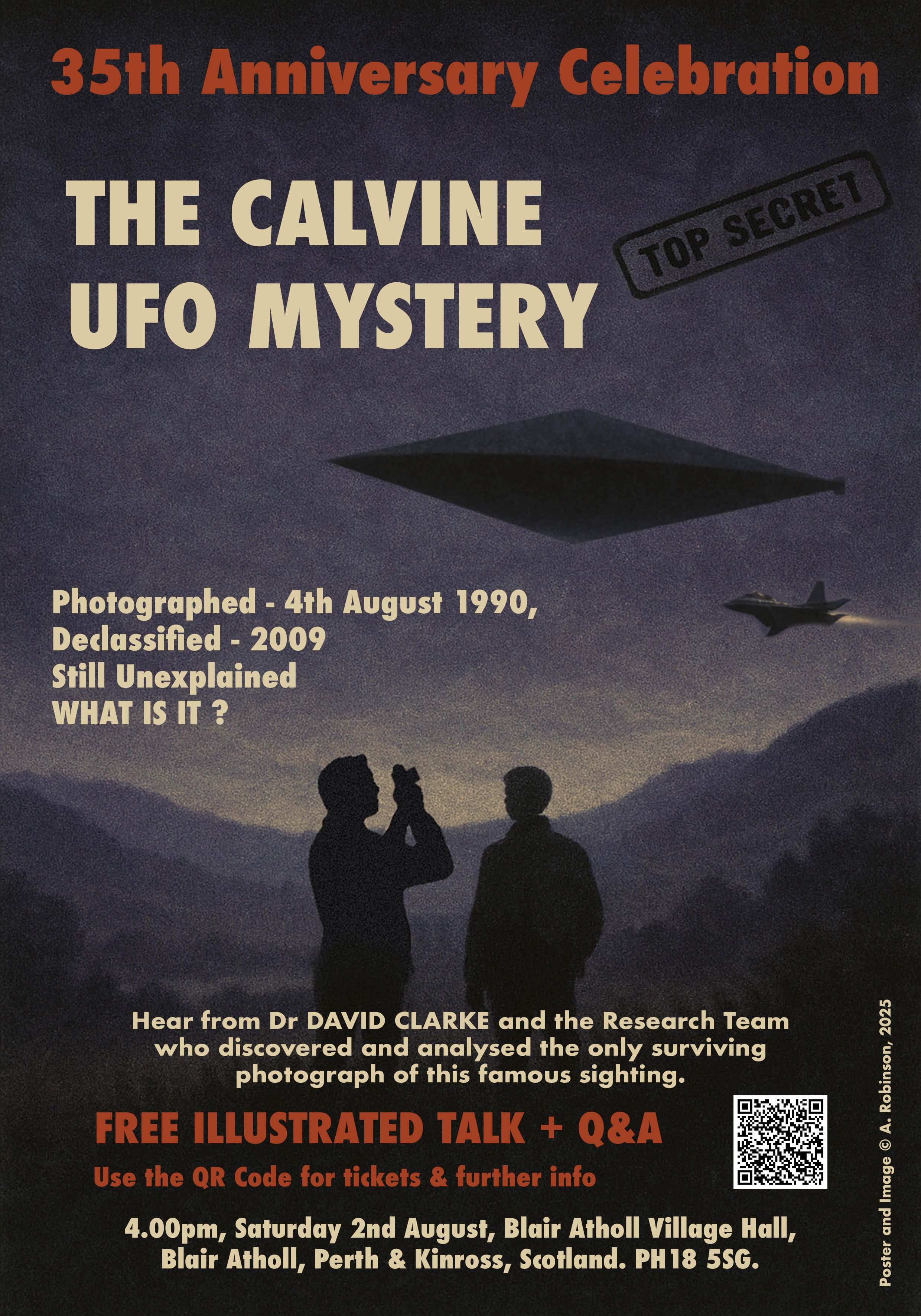
To mark the 35th anniversary of the unexplained sighting at Calvine, near Pitlochry in Perth & Kinross, a public talk will explore the mystery and the story behind the discovery of the only surviving print.
A poster for the 35th Anniversary celebratory talk concerning the mystery of the Calvine UFO Photograph
I will be joined by other members of the Calvine research team for the event at Blair Atholl Village Hall on Saturday, 2 August from 4-6 PM.
My world exclusive story in the Daily Mail in 2022, sparked heated debate amongst believers and sceptics. It revealed for the first time a photograph showing a diamond shaped object shadowed by a military jet above the highlands.
The image was one of six colour photographs allegedly taken by two mystery men on the 4th August 1990 on the hills above Calvine. The images were handed to the Scottish Daily Record who passed them to the Ministry of Defence in London for analysis.
The identity of the photographer and the ultimate fate of the images after they were received by the MoD remains a mystery, despite further media coverage in the Daily Mail and The Guardian.
In 2021 I tracked down the RAF press officer for Scotland, Craig Lindsay, who handled the story at the time and had interviewed one of the witnesses who was working at a hotel in Pitlochry.
Mr Lindsay, who retired in 2000, had kept a print of ‘the best’ image of the six for more than 30 years. In 2022 he donated it to Special Collections at Sheffield Hallam University where it was analysed by photography expert Andrew Robinson.
At the public event Andrew will discuss the results of his detailed study of the print which he claims ‘is a genuine photograph of a scene before the camera’. Team members Matthew Illsley and Giles Stevens will add their unique perspectives on the story and what the two men saw.
Since the release of the photograph, that has since been featured in numerous publications, documentaries and on social media, a multitude of theories have been suggested to explain it. These include a secret military aircraft, a rock or piece of wood in a loch, a mountain top peeking out of clouds, or a hoax constructed using a model hanging close to the camera.
I first came across a poor-quality copy of the image whilst leading the release of the Ministry of Defence’s UFO archives at the National Archives in 2009. As soon as I saw the image, I knew it was something special and I’ve been hooked by the story ever since.
The Calvine UFO photo has become world famous and rivals the Loch Ness monster as unsolved Scottish mystery. Currently it remains unsolved, and the final piece of the jigsaw is missing. It could be a hoax however it could also be a genuine photograph of an unidentified flying object.
We hope that people who live locally will come along to this event and make up their own minds about what really happened in 1990.
And we would love to hear from anyone with genuine new information that might help us solve the mystery – whatever that might be.
Free tickets for the event are available via the QR Code:
Extract from Will-O’-Wisp by John Clare (1793-1864)
Since the beginning of recorded history people from every profession and background have reported experiences with anomalous lights.
However they are described – most recently as UAP, UFO, flying saucer or just plain old fashioned unexplained lights – they always hover at the boundaries of our perception.
Statue of ‘the peasant poet’, John Clare (1793-1864) at the cottage museum where he was born in Helpston, Cambridgeshire (Copyright David Clarke)
Much is made of the reporting skills of police officers, astronomers, aircrew and military pilots who report unidentified flying objects. But what about our writers and poets who are keenly aware of their surroundings and the world around them? They are also trained observers who, by nature of their calling, absorb details that are often translated into vivid imagery.
William Blake is of course famous for the mystical visions that he experienced throughout his life, including the angels, demons and other spiritual entities that accosted him in everyday places, from windows to stairwells.
Lesser known but equally profound are the weird encounters with anomalous lights and other supernatural creatures that are described in the prose and poetry of John Clare. The so-called ‘Peasant Poet’ was born in 1793 at the Fenland village of Helpstone, now in Cambridgeshire but at that time in Northamptonshire.
A Christmas story from Britain’s Roswell: the Rendlesham Forest UFO legend
‘What the hell is it?… Who is in charge?’
These were the questions that Airman 1st class Kurt Loutzenheiser asked US Air Force Security Police when he was confronted with a landed object deep inside Rendlesham Forest, Suffolk, England
The UFO sculpture on the Forestry Commission UFO trail in Rendlesham Forest Suffolk, photographed in 2019 (credit: Roger Clarke)
It was a pitch black night and the NATO complex, that included USAF-controlled RAF Bentwaters and RAF Woodbridge, separated by the forest, was closed for the Christmas holidays.
To continue reading this story please join or subscribe to my Substack blog here.
A sample of traditional English calendar customs (Image Copyright Andrew Robinson 2024)
In Charlie Cooper’s new seriesMyth Country (streaming on BBC I-player) the actor and writer reveals his passion for folklore and how the peculiar rituals and traditions of this country ‘bring people together’. Far from being outdated and trivial, folklore is, he says, ‘very much alive and thriving on social media’.
The National Folklore Survey, funded by UKRI Arts & Humanities Research Council (AHRC) Catalyst award, addresses the lack of robust research evidence into the cultural value of folklore in post-Brexit, post-pandemic multicultural England. It aims to create new data to answer two research questions: ‘How have folkloric beliefs and practices shaped England’s social, cultural and spiritual identity?’ and ‘To what extent are ideas of nationalism and colonial attitudes informed by contemporary notions of English folklore?’.
I am the Project Lead and Co-leads include my colleague Dr Diane Rodgers from Centre for Contemporary Legend at SHU along with Dr Ceri Houlbrookand Professor Owen Davies, who founded the MA Folklore Studiesat the University of Hertfordshire. The project’s international Co-Lead is Professor Christopher Bader, chair of the Department of Sociology, Chapman University, California, who has directed two large belief surveys in the USA.
The project aims to capture an accurate snapshot of the folklore of multicultural England and gain a new understanding of the impact of colonial and empire narratives on previous surveys. The timing is important as 2024 marks the 60th anniversary of the original Survey of Language and Folkloreat the University of Sheffield and the ratification by the UK Governmentof the UNESCO convention for Safeguarding of the Intangible Cultural Heritage (ICH). The new survey will produce new knowledge, insights and understanding of contemporary English folk culture at a time when many individuals and communities feel what historian and broadcaster David Olusoga described as ‘a conflicted sense of identity’.
The overarching project aim is to provide an empirical evidence base for the analysis of contemporary English folklore through the development and deployment of a national survey, commissioned from IPSOS-UK, in the first year of this project. The rich dataset will be used to develop a range of accessible outputs for the academic, policy, heritage sectors and wider general publics that will raise awareness of the value of folklore as a cultural asset. This will be accessible via an online platform for data gathering, along with open data analysis after the initial survey is completed. This will be followed, in the second year of the project, by a public engagement/outreach programme to create and capture evidence of impact.
Direct beneficiaries include The Department for Digital, Culture, Media and Sport, via the planned ratification of UNESCO Convention on Intangible Cultural Heritage; the AHRC-funded Folklore Without Bordersnetwork that is working to develop greater diversity within folklore; and the GLAM sector (galleries, libraries, archives and museums) via our knowledge exchange with project partners The Folklore Society, The Folklore Library and Archive and the Folklore Museums Network. The FMN estimates that #NFS data will directly inform displays and interpretation in one third of all museums in England. The strong evidence basis produced by this project is designed to create better understanding and awareness of the cultural value of folklore as a source of resilience and community identity. The potential applications, highlighted in the DCMS public consultation, include raising awareness, building participation, ensuring sustainability and supporting the passing on of traditional knowledge.
Did aliens build the mysterious Nazca lines in the Peruvian desert?
Are they linked with the so-called ‘Nazca mummies’ recently promoted as ‘non-human’ fossils that some claim are more than 1,000 years old?
The answer to these two questions is a simple No….
But the complete lack of evidence to support these beliefs does not convince those who appear in the American TV series Ancient Aliens, currently in its 20th season (254 episodes).
The current revival of interest in the fascinating ancient astronaut mythology is the subject of my most recent by-lined feature in the Daily Mail/MailOnline(paywall).
To read further please subscribe to my Substack blog.
The latest revelations about the ‘Pitlochry Thing’
The mysterious Calvine UFO photographs are making headlines again – with the latest on my investigations published by the Daily Mail.
This graphic prepared by Andrew Robinson compares the original Calvine image [left] with the photocopy faxed from RAF Pitreavie to MoD Sec(AS) in 1990 [centre] and the photocopy of the Calvine sighting released by The National Archives in March 2009 [right]. Red boxes highlight identifying features found on all three images. When the images are overlain both planes line up exactly on all three images
My new story opens with the narrative of former chef Richard Grieve who claims he worked alongside the two young men who saw and photographed the diamond-shaped object north of Pitlochry one night in August 1990.
Richard Grieve first came forward in July 2022. He said ‘the two people who took the photograph were chefs at Fishers Hotel in Pitlochry…I know this to be true as I worked in the hotel at the same time’.
Another development in that our ongoing investigation of the mystery has now produced proof that the Calvine photograph is one of the original six images analysed by the Ministry of Defence in 1990.
My Sheffield Hallam colleague, photography specialist lecturer Andrew Robinson, has carried out a detailed computer analysis of the image donated to the university library Special Collections by Craig Lindsay in 2022.
The latest version of Andrew’s report can be downloaded here
And to read about the latest developments in the Calvine story please subscribe to my Substack blog.
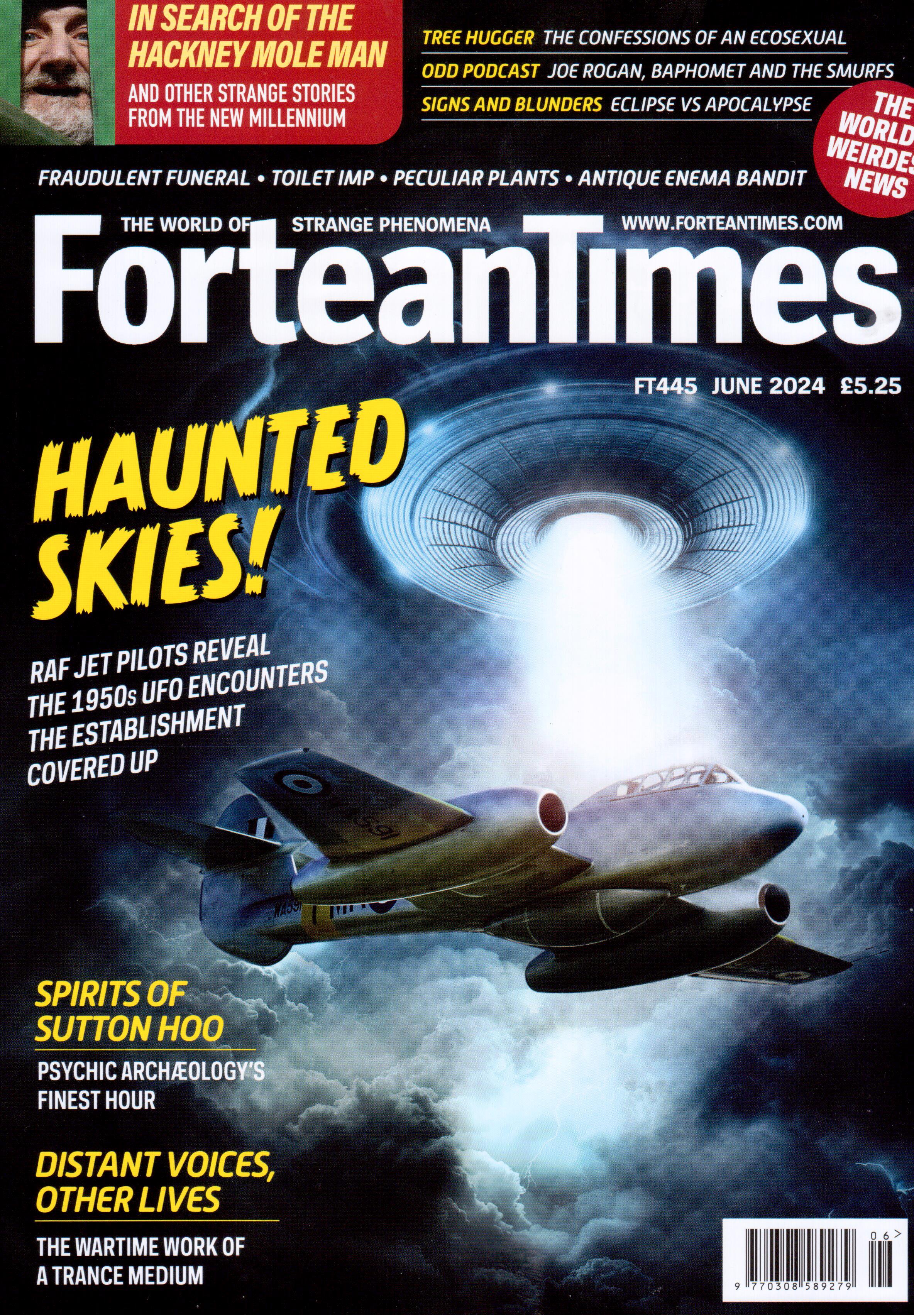
RAF test pilots reveal their close encounters with UFOs
UFOs – or UAP – are a worldwide phenomenon. Since 2017 when new testimony from US Navy aircrew first emerged media attention has been focused on North America. But British military pilots have reported close encounters with ‘unidentified aerial phenomena’ since 1916.
During my research for the UK National Archives UFO project (2008-2013) I interviewed 25 retired and serving aircrew who served with the Royal Air Force and Fleet Air Arm. All had reported encounters with ‘aerial phenomena’ between 1944 to 1966, when such things were known as flying saucers or UFOs. An even larger number were ground based personnel who tracked anomalous phenomena on radar.
A number of US Presidents have expressed an interest in UFOs and extraterrestrials but only one has ever reported a sighting: Jimmy Carter. The 39th President held office from 1977 until 1981 during a period of intense public interest in UFOs.
Soon after Carter took office Sir Eric Gairy, president of the small Caribbean island republic of Grenada, called upon the United Nations General Assembly to make 1978 ‘the year of the UFO’. His attempts failed to gain any traction but the release of Steven Spielberg’s blockbuster movie Close Encounters of the Third Kind – with its plot based around a government conspiracy to hide direct contact with friendly ETs – raised the political stakes.
During the election campaign in 1976 Carter said: ‘one thing’s for sure I’ll never make fun of people who say they have seen unidentified objects in the sky. If I become President, I’ll make every piece of information this country has about UFO sightings available to the government and the scientists’.
Carter’s interest was a direct result of his own experience in 1969, two years before he became Governor of Georgia. On the evening of 6 January he was preparing to speak in the town of Leary when one of the guests drew his attention to a bright white light, 30 degrees above the horizon, to the west of their position. As he and a dozen others watched, the light appeared to move towards them to hover behind a belt of pine trees. It changed colour from blue to red and then back to white. Eventually the light, that he compared to the size of the full moon, disappeared into the distance. Carter later filled out a NICAP UFO sighting questionnaire but his story only emerged in 1976 when he told the National Enquirer ‘It was the darndest thing I’ve ever seen …none of us could figure out what it was’….
The summer of 2023 may mark the highpoint of a renewed resurgence of interest in UFOs both in the corridors of the Pentagon and for the world’s media. But all the online debate around whistleblowersand imminent disclosure obscures the fact that UAP are a global phenomenon.
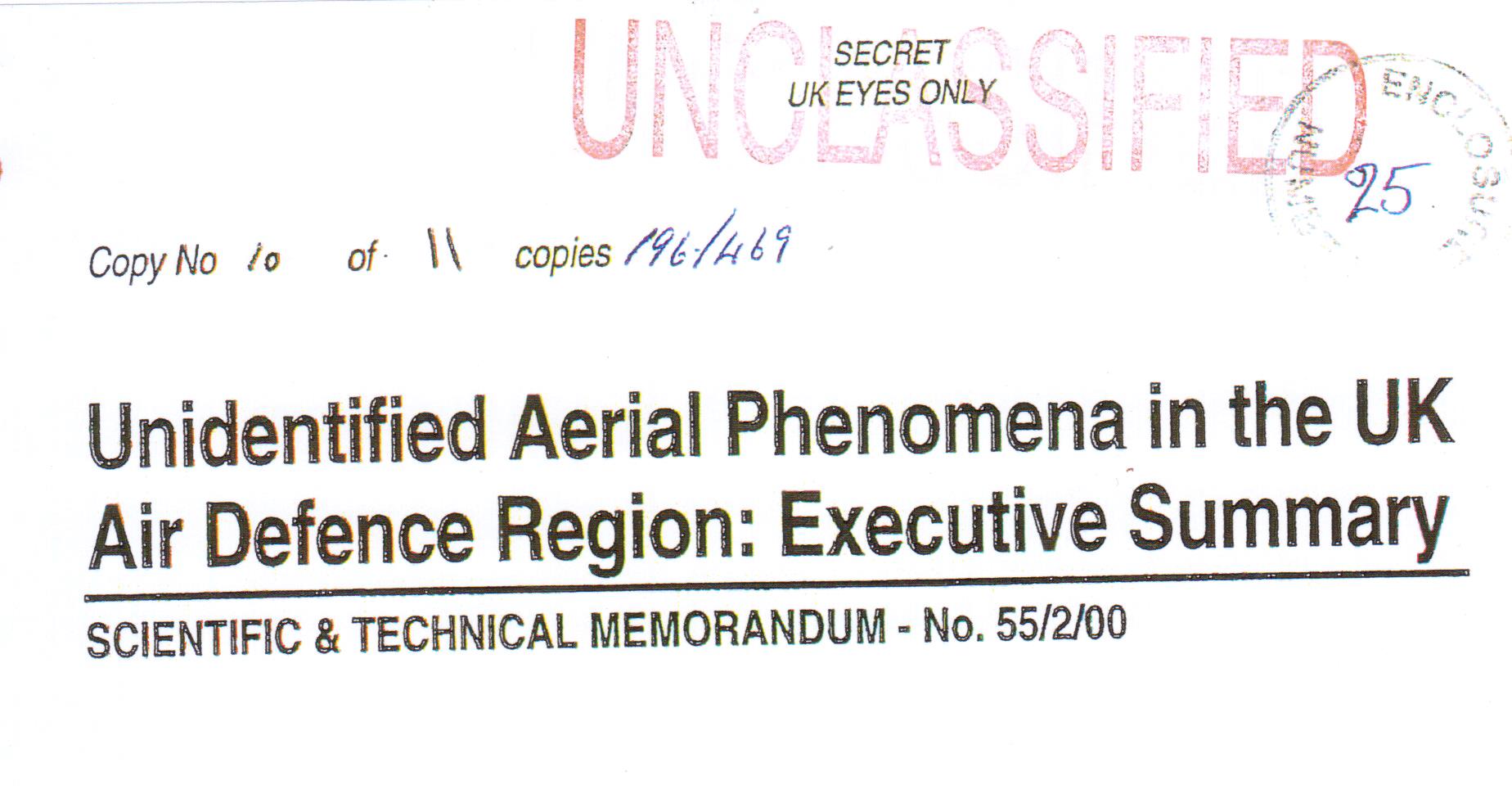
Cover image from vol 1 of Project Condign report
So far the response of the UK government to US intelligence interest and NASA’s separate, ongoing study, has been muted. The official line is that MoD closed its UFO desk in 2009 after some 50 years acting as the focal point for sightings reported by members of the public. This followed the transfer of its surviving files to The National Archives, a process for which I acted as consultant. If you believe MoD’s boilerplate responses to recent FOI requests, the UK government has no further interest in the phenomenon.
But as Prime Minister Harold Macmillan may have once said ‘events, dear boy, events’ have a habit of changing game plans. In July 2021, after the US Director of National Intelligence released its second ‘preliminary assessment’ of UAP, Lord Aamer Sarfraz put the UK MoD on the spot during a mini-debate in the House of Lords. The Conservative peer, who sits on the National Committee of the Joint Security Strategy, wanted to know if as a result of the change in US policy the MoD planned to reopen its UAP investigations and what data it held.
David Clarke is Associate Professor in the Department of Media Arts and Communication at Sheffield Hallam University, UK. He teaches media law and his research specialism is contemporary legend. Previously he worked as a journalist for The Sheffield Star and Yorkshire Post and spent four years working as a Press Officer in local government. His PhD in Folklore and was completed at the National Centre for English Cultural Tradition, University of Sheffield, in 1999. From 2008-13 he acted as consultant and curator of the MoD UFO files project with The National Archives. His books include The Angel of Mons (2004) and How UFOs Conquered the World: the history of a modern myth (2015). In 2018 he co-founded the Centre for Contemporary Legend at Sheffield Hallam University. This blog covers his twin research interests in journalism and folklore. The views expressed in the contents are entirely his own.
What is Folklore?
Once upon a time… ‘Folklore’ meant ancient ballads or fairy tales or the peculiar superstitions and customs of ‘primitive’ peoples. Today folklore is a tool for studying custom and belief, urban legends, modern myth and even rumours spread via the internet. Much folklore can be found online and buried in the narrative content of media and social networking - from legends and reports of ghosts, UFOs and 'big cats' to language, customs and traditions. The study of folklore is centrally and crucially important 'in our attempts to understand our own behaviour and that of our fellow human beings' according to one scholarly definition. Folklore is a vital and ongoing area of study and one of the few academic disciplines that engage, in a fundamental way, with everyday life.
Centre for Investigative Journalism (CIJ)
City University’s centre of investigative excellence. Visit for info on the CIJ summer schools and workshops on investigative techniques.






 David Clarke is Associate Professor in the Department of Media Arts and Communication at Sheffield Hallam University, UK. He teaches media law and his research specialism is contemporary legend. Previously he worked as a journalist for The Sheffield Star and Yorkshire Post and spent four years working as a Press Officer in local government. His PhD in Folklore and was completed at the National Centre for English Cultural Tradition, University of Sheffield, in 1999. From 2008-13 he acted as consultant and curator of the MoD UFO files project with The National Archives. His books include The Angel of Mons (2004) and How UFOs Conquered the World: the history of a modern myth (2015). In 2018 he co-founded the Centre for Contemporary Legend at Sheffield Hallam University. This blog covers his twin research interests in journalism and folklore. The views expressed in the contents are entirely his own.
 drdavidclarke.co.uk