Britain’s secret ‘Death Ray’

The Sunday Express has published a story based upon the British military’s work to create a high energy ‘death ray’ weapon for use in the Falklands War.

A document written by the former Secretary of State for Defence, Michael Heseltine, for Prime Minister Margaret Thatcher in the aftermath of the conflict in 1983, revealed how the Task Force had deployed ‘a naval laser weapon, designed to dazzle low flying Argentinian pilots attacking ships‘.

Heseltine’s letter was among Cabinet papers released by The National Archives in 2013. It forms part of the dossier of material used in my book, Britain’s X-traordinary Filesthat traces the British government’s long obsession with death rays.

In his briefing to Thatcher, Heseltine says: ‘This weapon was not used in action and knowledge of it has been kept to a very restricted circle’.

Ever since H.G. Wells imagined invading Martians who used deadly heat rays to conquer the Earth, military top brass have sought to perfect a destructive ‘ray’ that could be used to spread terror among enemy soldiers and destroy enemy bombers before they reached their targets.

The inventor Nikola Tesla (1856-1943) made one of the earliest proposals for a working death ray. But in 1924 Harry Grindell-Matthews – or ‘Death Ray’ Matthews as he was dubbed by the Press – claimed to have perfected a device that could ‘melt glass, light lamps, explode gunpowder…and stop aeroplanes in flight.’

But Matthews failed to impress the Air Ministry with his demonstration of the ‘ray’ and took its secrets to his grave.

Before the Second World War the War Office offered a standing reward of £1000 to anyone who could produce a death ray that was a capable of killing a sheep at one hundred yards.

Numerous ‘secret inventors’ competed with each other to perfect the weapon without success.

The development of the air defence radar was one direct outcome of attempts to claim the prize. Papers I discovered at The National Archives revealed how British intelligence deliberately planted rumours about secret work on death rays to distract enemy attention from the real purpose of the Air Ministry’s Chain Home radar stations around Britain’s coastline.

But the nearest Britain came to deploying such a hi-tech weapon in WW2 was during the Desert War in North Africa in 1942. After the conflict magician turned wartime wizard Jasper Maskelyne claimed he had used an array of powerful searchlights as an improvised ray to dazzle Luftwaffe pilots during their attempts to bomb the Suez canal. But his claims, that he published in Magic: Top Secret (1949) have never been substantiated.

Ever since WW2 military scientists have continued to experiment with death rays under strict secrecy. The documents opened at The National Archives revealed how British scientific intelligence were working secretly with United States during the 1980s to develop high powered laser weapons for use against Soviet armour in the event of a war in Europe.

In his 1983 correspondence, Michael Heseltine said spy chiefs feared Russia would be ready to field a range of secret beam weapons by the mid-1980s, including a generator mounted on a truck delivering high-power microwave radio frequency blasts.

Intelligence chiefs claimed this could affect the electronics systems of low-flying aircraft and attack the human central nervous system.

It was also feared the Soviets were working on chemical shells and missiles to deliver high-powered electromagnetic pulses that would jam electronic systems such as Nato radars.

Since then technology has moved to direct-energy weaponry aimed at disabling missiles, armoured vehicles and mobile phones.

Posted in Uncategorized | Tagged , , , , , , , , , , , , , , | 1 Comment

British Army tried to harness ‘supernormal’ powers in WW2

Records I discovered at The National Archives show the British Army’s top brass tried to harness ‘supernormal‘ powers during the war against Hitler – and may still be conducting experiments on a range of special powers.

An article by Mark Branagan in The Sunday Express summarises the research published in my 2014 book Britain’s X-traordinary Files (Bloomsbury):

During the Battle of Britain and Blitz they began tests to see if unexploded bombs and mines could be detected with water divining rods.

The idea of using the para­normal even reached war leader Winston Churchill’s ears and, when victory in Europe was secured, it continued to obsess military boffins for decades.

They persevered with their efforts to use troops armed with divining rods to strike fear in enemy hearts for another 30 years before finally ditching it as unworkable.

The notion was inspired in 1940 when officials heard of a policeman using a divining rod to search for victims of a Nazi bombing in Warwick. Word of it reached Herbert Morrison’s civil defence department, which reported to Churchill.

In an experiment in 1940, a dowser was used to explore the gardens of the National Physical Laboratory in Teddington for buried objects. His trusty rod failed to detect a large gas main running 2ft under the grounds or a bomb case in an underground trench. Dowsing was written off as “completely unreliable”.

Yet by 1968, with British forces in difficulties in Aden, experi­ ments were recommenced. A dummy minefield was laid over a 384­acre heath in Dorset and dowsers were called in.

They failed to find any of the 400 explosives, either by walking the ground or trying to locate them on maps.

A 1941 file on the policeman’s claims, which were debunked, was found in the National Archives by Sheffield academic Dr David Clarke, who also found a dossier on the later experiments. He has written a book called Britain’s X­traordinary Files.

He said yesterday: “Dowsing, divination and other super­ natural powers sound like some­ thing from The X­Files.

“Yet during wartime the Brit­ ish government was prepared to consider all kinds of unconven­ tional methods to gain a tactical advantage over the enemy.

“I would be surprised, in the aftermath of 9/11 and with the war on terror, if the military are not still working on super-normal experiments.”

Posted in Uncategorized | Tagged , , , , , , , , , , , | 2 Comments

On the trail of the phantom copter

The Daily Mirror has published the results of my Freedom of Information research on the phantom helicopter mystery that plagued British police forty years ago.

A typical news headline from 1974

A typical news headline from 1974

The full story was published in Britain’s X-traordinary Files and a summary can be found on my Case Files pages. Here is an excerpt Mirror’s version:

A phantom helicopter which spooked the nation in the 70s was feared to be an IRA terror weapon ready to be unleashed on the mainland, it has emerged.

Secret Scotland Yard files have revealed how police, Special Branch, MI5 and the MoD desperately tried to hunt down a daredevil pilot making night-time flights over rural England.

A Special Branch memo said: “The IRA has access to and is believed to have used a helicopter for training purposes in the Derbyshire area”.

From 1973 there were numerous sightings of a helicopter flying illegally over the Peak District during a period of 12 months.

Police received reports the helicopter was seen flying without lights as low as 100ft.

The ghost helicopter hit the headlines in the Daily Mirror with one pilot explaining at the time: “This guy’s a madman – or a great flier.”

Now, more than forty years later, papers obtained under the Freedom of Information Act reveal the police and security services had fears this helicopter was being used by the IRA.

Top policeman George Oldfield, who later led the Yorkshire Ripper hunt, was told by an informant, a helicopter crew had been carrying out “target practice” in the Peaks.

There were also concerns the IRA planned to spring terrorist prisoners from maximum security Wakefield Jail and had been plotting to steal lethal explosives from a quarry.

Dr Dave Clarke, an academic at Sheffield Hallam University, who uncovered the papers, said: “These documents show the security services were concerned that terrorists might have the ability to attack Britain from the air thirty years before 9/11, using hijacked helicopters or even light aircraft.

“There was talk of using the Harrier jump jet to intercept the mystery helicopter at night over the Peak District.

“They never discovered who the devil-may-care pilot was and how he managed to fly his machine in darkness in such a foolhardy way without coming to grief.

“The whole phantom helicopter story reads like something from a James Bond novel.”

Read more here. The Mirror story follows media coverage of my research into MI5 investigations of mysterious ‘crop markings’ and lights in the sky that were linked with German Fifth Columnists during the Second World War. The Mail Online story can be found here and my 2013 blogpost on the MI5 dossier is here.


Posted in Uncategorized | Tagged , , , , , , , , , , , , , , , | 2 Comments

Common Sense About UFOs – The Unopened File

Britain’s Ministry of Defence is often accused of hiding ‘top secret’ files on UFOs or not being entirely honest about what it knows about the subject.

Conspiracy-minded UFO truthers got excited last year when the ministry announced it had found another 18 files that had not been included in the tranches released by The National Archives between 2008 and 2013.

Every large government body regularly loses or misplaces paperwork and it came as no surprise to me that ‘new’ files had turned up. But I predict that when  these files are released, and fail to contain any new evidence either of alien visitations or any other far-out conspiracy theory, they will be dismissed as yet another whitewash.

Further claims will be made about other, more top secret files, squirreled away in some hidden location elsewhere.

I can say this because I obtained copies of a number of these so-called ‘missing files’, using Freedom of Information requests, years before 2007, when the MoD decided to transfer the contents of its surviving archive en masse to The National Archives.

One fascinating document that has yet to surface is an educational pamphlet prepared in 1979-80 by the then head of the ministry’s now defunct ‘UFO desk‘.

Despite a year’s work on the project – that involved consultation with the RAF, the intelligence services, and scientists at Jodrell Bank radio telescope and Greenwich Planetarium – the MoD decided to pull the plug and the project was quietly filed away and forgotten.

Was this because of a sinister plot by the New World Order to prevent the populace from learning about the imminent threat to Earth posed by extraterrestrials?

Or is it more likely the MoD decided their draft Common Sense About UFOs contained too many inconvenient truths? In effect, it was a case of ‘you can’t tell the people’?

Judge for yourself.

I have transcribed a copy of this document from the original file that, with delicious irony, is not among the 18 earmarked for release by MoD later this year.

In doing so, I tidied up the draft text prepared by Colonel Paddy Stevens for publication by HM Government after the House of Lords UFO debate in January 1979.

The document begins by listing some of the common explanations for strange phenomena in the sky that are often labelled as ‘alien space craft’ by UFOlogists and the mass media, from fireballs to meteorological balloons (today, we can add Chinese lanterns and remotely-controlled drones to this expanding list).

Then Stevens moves on to tackle ‘how the UFO myth arises’, looks at close encounter stories, asks ‘where are the aliens hiding?’ and responds to claims ‘that many world governments have conspired for 30 years in a great cover-up’ of the alien presence.

Although this document is 35 years old, when I first came across it I knew that its contents remain as relevant today as they were in 1977-78 following the release of Spielberg’s movie Close Encounters of the Third Kind.

The author, Colonel Patrick (‘Paddy’) Stevens OBE, a former Royal Marine commando, was the head of the MoD’s UFO desk, S4(Air) in 1978-80. It was Stevens who helped talk down a call by UFO enthusiast Sir Eric Gairy, who was then president of the Caribbean nation of Grenada, for the United Nations to make 1979 ‘the year of the UFO.’

And the file reveals that it was also Stevens who personally drew up the government’s response to the famous House of Lords debate on UFOs.

The debate, in January 1979 was initiated by Brinsley le poer Trench (Lord Clancarty), a well-known proponent of UFO and ancient astronaut beliefs who believed flying saucers had a base inside the hollow Earth and flew out through holes in the poles. When Clancarty tabled his debate, Stevens warned his colleagues at Whitehall:

‘We do not take this lightly because Lord Clancarty is an acknowledged expert on UFOs, whilst MoD has no experts on UFOs for much the same reasons as we have no experts on levitation or black magic.’

Like the majority of the other UFO desk heads, Col Stevens was an avowed sceptic when it came to aliens.

But unlike his predecessors he directly challenged those who wanted to force the MoD to commit more time and resources to investigations.

And he was keen to promote his sceptical views in public, taking part in a live Yorkshire TV debate on UFOs presented by the late Richard Whiteley, in January 1979.

In 1978 as the Lords debate approached, Stevens advised Labour Defence Minister Fred Mulley to adopt an ‘unequivocal and uncompromising line’ on UFOs and added:

‘There is a temptation to equivocate about UFOs because of the thought that one day we may make contact with people from distant stars…however, there is nothing to indicate that ufology is anything but claptrap and no evidence of “alien space craft”. The UFO industry has prospered from equivocation and, with 1979 being hailed as “the year of UFOs”, it is highly desirable for HMG to inject some massive common sense into the business.’

Steven’s stint as a senior and influential civil servant at the MoD followed a long career in the military. In 1940, at the age of 19, he joined the Royal Marines as a probationary second lieutenant and on D-Day he landed on Sword Beach with 41 Commando in the face of fierce enemy fire. After losing half its strength and its senior officer, he was promoted to company commander and led his men deeper into France.

After WW2 he was posted to the Royal Military Academy at Sandhurst and as a major he served in various regimental and staff posts until he was given command of 45 Commando during the Aden crisis. In 1963-64 he took part in deep penetration raids into enemy territory and wrote up his experiences in a book, The Long Summer, published posthumously in 2009.

By the 1960s Paddy Stevens joined the NATO International Military Staff in Brussels before joining the civil service, where he was promoted to assistant secretary and then in 1977 to head of S4 (Air) in the Ministry of Defence, Whitehall.

He left the UFO desk in 1980, shortly before the famous sighting of ‘mysterious lights’ in the Rendlesham Forest, near RAF Woodbridge, became a cause celebre for the UFO industry.

He ended his career as Head of the Naval Law Division and died in 1998, one year after the 50th anniversary of UFOlogy. His last words on UFOs were:

‘Of course there are UFOs, in the sense of things which are seen in the sky and require explanation, but there are perfectly straightforward explanations for them. As for the idea of a cover-up, the arrival of just one alien space craft would be a stunning event. The skies full of alien space craft, as the UFOlogists claim, could never be kept hidden from the scientific community even if the government wished. Any idea of a cover-up must therefore include the scientific community. Anyone who believes that will believe anything.’

*Thanks to Judy Stevens for biographical information and access to photographs of her late husband in the writing of this blogpost.

Posted in Uncategorized | Tagged , , , , , , , , , , , , , , , , , , , , , , , , , , , , , | Leave a comment

Cat’s out of the bag?

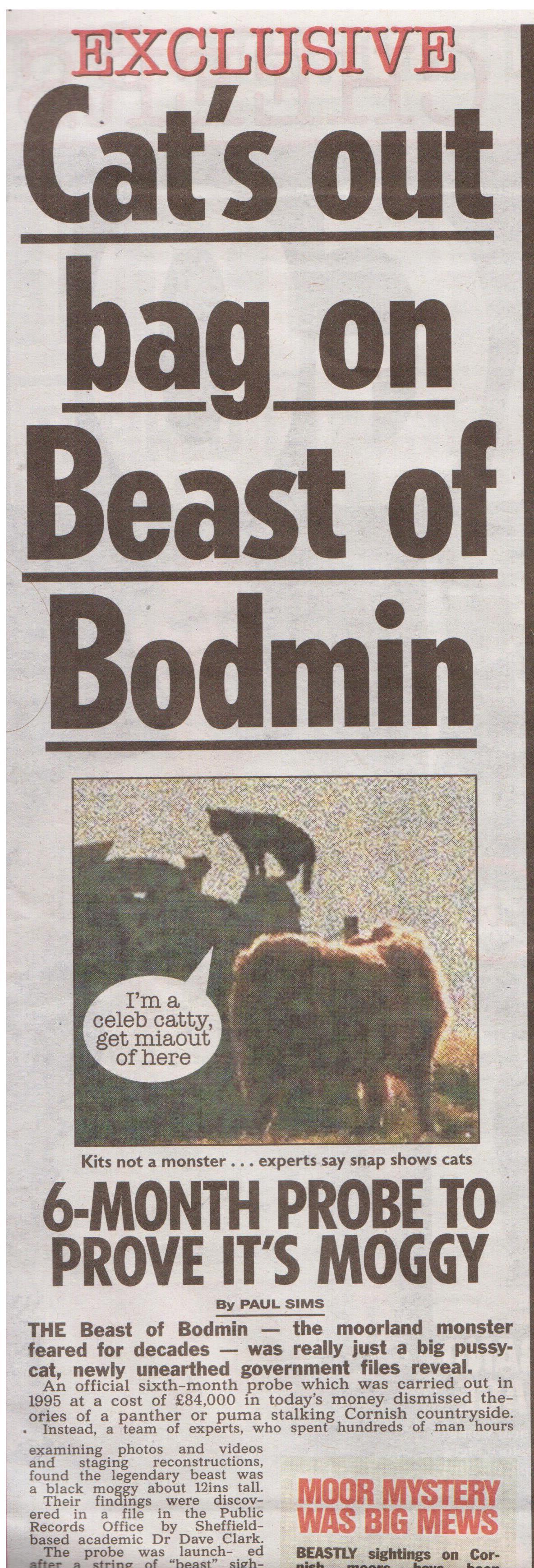
The Beast of Bodmin Moor was really just a large domestic cat according to a study commissioned by the British government.

Two tabloids, The Sun and the Daily Mail, revealed the results of the 1995 investigation, based upon information taken from a chapter in my book Britain’s X-traordinary Files, published by Bloomsbury in September.

The story follows the scare in November in which soldiers and armed police searched a suburb of Paris after sightings of ‘a young tiger‘ near  a supermarket. A lengthy search of the area failed to locate the tiger or any trace of an escaped cat.

And two years ago police in Essex spent £25,000 using helicopters and marksmen to search a caravan park near St Osyth after holidaymakers reported seeing a lion on the prowl. Again nothing was found and the story quickly slipped out of the headlines.

The Sun 'exclusive' pg 3 Monday, 15 December 2014

The Sun ‘exclusive’ pg 3 Monday, 15 December 2014

What makes us see mystery big cats where they don’t exist? Does the report on the Cornish beast provide us with answers?

Firstly what The Sun calls the ‘newly unearthed government files’ about the Beast of Bodmin have been in the public domain since shortly after the study was published in 1995.

But their contents have been ignored, possibly because they make uncomfortable reading for those who believe that large undiscovered felines are living secretly alongside us in the British countryside (see also Doubtful News post on the role played by the media).

The short but thorough report by the environmental consultancy ADAS was commissioned by the former Ministry of Agriculture Fisheries and Food (MAFF) – now the Department for the Environment – in response to what it called

‘continued concerns expressed by people living in the area…that such animals might become established and pose a significant threat to livestock.’

The investigation was widely advertised in Cornwall, with farmers and members of the public invited to submit evidence to inspectors. From the outset, ADAS admitted it would never be possible to prove that such an animal, or animals, did not exist.

But they believed if it did hard evidence would be found and the team spent six months collecting sightings, videos and still photographs and reports of suspected livestock kills and injuries.

The report proved a devastating blow for those who believed the Beast of Bodmin Moor was a real big cat. The team used large measuring poles to demonstrate the heights of walls and other natural features against which some of the creatures had been photographed.

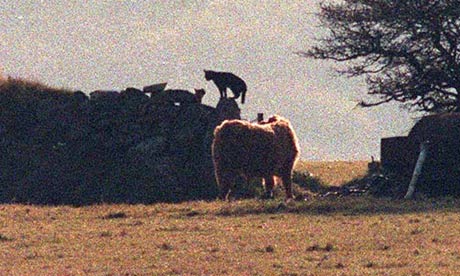
One classic photograph of the ‘Beast of Bodmin Moor’, taken by press photographer using a long focus lens, appeared to show two ‘big cats’ posing on a stone wall, with one balanced upon a gatepost.

Press photo showing 'the beast'....the creature was later found to be 12 inches tall

Press photo showing ‘the beast’….the creature was later found to be 12 inches tall

When this was re-photographed with a one metre tall ranging pole providing scale to the gatepost, the ‘beast’ was clearly shown to be no taller than 30cm (12 inches) tall at the shoulder. It was, in fact, a domestic cat.

Several other still photographs and video sequences, taken in daylight, were subjected to the same technique. In each case, the black animals depicted were revealed as no larger than domestic felines.

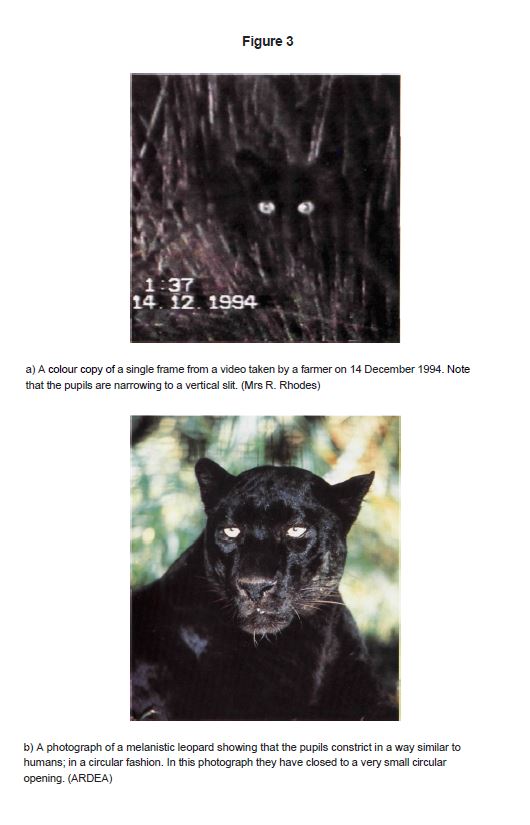
One sinister night-time shot that claimed to show the eyes of a young leopard in close-up was compared with an image of a real black leopard. The pupils of the ‘beast’ photographed in Cornwall could be clearly seen in the light of the farmer’s lamp as narrow vertical slits (see image, below right). This type of constriction is not found in the pupils of larger cats like leopards and pumas. The investigators concluded the animal in the photograph was a domestic cat.

A page from the ADAS report on the Beast of Bodmin (Crown Copyright)

A page from the ADAS report on the Beast of Bodmin (Crown Copyright)

Examination of footprints and alleged big cat ‘kills’ were equally disappointing. Three plaster casts of prints taken on Bodmin Moor were examined and it was concluded that two belonged to an ordinary cat and the third to a dog.

Of the small number of livestock kills that were followed up by the team, none produced any evidence for the presence of big cats. Traces of indigenous predators, such as badgers, crows and foxes were found, in most cases as scavengers after sheep had died from natural causes.

In 1998 Labour Elliot Morley MP, the parliamentary secretary for the Ministry of Agriculture, Fisheries and Food, was quizzed about the study in Parliament (read the extract from Hansard here).

He said his prime concern was the potential threat big cats, if they existed, might pose to livestock. Morley said his officials received many such reports every year and although the ‘vast majority of reports are not genuine sightings of big cats’ the subject was regarded as ‘a serious issue’ by the government.

In his book Feral the journalist and environmental lobbyist George Monbiot asks why there has been so little discussion of the big cat sightings in the scientific literature. Monbiot interviewed a number of people near his home in West Wales who have seen a large black cat, said to be 6ft in length and 3ft high, that has been dubbed ‘the Pembrokeshire Panther’.

He became convinced of their sincerity and their claim to have no prior knowledge or interest in the subject before their personal experience with a big cat. Nevertheless, he found it impossible to accept such creatures could be so common without hard evidence emerging of their existence.

After consulting psychologists, Monbiot began to realise how witnesses could turn ordinary cats into extra-ordinary ones by magnifying their size out of the context of their surroundings, as the analysis of photographs taken on Bodmin Moor proved.

Monbiot speculated ‘whether there might be a kind of template in our minds in the form of a big cat’ that we have inherited from our ancestors. When we are confronted with something ‘that vaguely fits the template’, in sudden and unexpected circumstances, ‘the template triggers the big cat alarm’.

The influence of mass media stories and images of big cats from zoos and films may also play a part in shaping how such ‘sightings’ are interpreted by eye-witnesses.

Perhaps next time the police receive a sighting of a ‘mystery big cat’ prowling the suburbs of a city or town they might consult a folklorist or a psychologist first before they call out the marksmen or scramble helicopters.

But they should always check with the local zoo, just in case there have been any escapes by genuine wild animals…


Posted in Uncategorized | Tagged , , , , , , , , , , , , , , | 1 Comment

Nessie: shoot on sight!

The Sunday Express has published a summary of my research into official files on The Loch Ness Monster. The article by Mark Branagan is headlined: ‘The day big game hunters were called in to kill Nessie…and almost sparked war’ and begins:

‘It was a tourist attraction and a national treasure to those dreaming of an independent Scotland. Now previously unpublished documents can reveal that when London put a bounty on landing the Loch Ness Monster in the 1930s, big game hunters were not the only ones sharpening their harpoons for the kill….

‘Now previously unpublished documents can reveal that when London put a bounty on landing the Loch Ness Monster in the 1930s, big game hunters were not the only ones sharpening their harpoons for the kill.

‘In fact, the normally demure Natural History Museums of England and Scotland were also at each other’s throats… over who would get the carcass, while there concern among the newly re-emerging Scottish Nationalist movement that the monster’s dead body might be put on show in London.

‘The story has been uncovered by Sheffield based author David Clarke for his new book, Britain’s X-traordinary Files.

‘Clarke already knew about the Nessie Files in Edinburgh but was “astonished” to find another set at the Natural History Museum. “Many influential people, including MPs and famous naturalists like Sir Peter Scott, believed in the existence of Nessie and a lot of pressure were placed on the Scottish Office to give it special protection,” he says.

‘Indeed when sightings began again after the war, the Duke of Edinburgh suggested calling in the Royal Navy to solve the mystery.

‘“During the 1930s the Monster became an important symbol for Scottish Nationalists who wanted the police to protect the creature from big game hunters,” adds Clarke. “Nessie had become a Scottish icon, a symbol of national identity. There was genuine outrage at the possibility that the corpse of the monster might be taken for display in London.”

‘By 1934, both the Natural History in Museum in London and the Royal Scottish Museum in Edinburgh wanted Nessie, dead or alive. Yet while Scotland hoped that the bounty hunters could be kept at bay long enough to get new laws passed to protect the creature, London preferred it shot on sight.

The Scottish Office opened a file on the monster in December 1933 after being bombarded with inquiries from the Press.

‘Now “Nessie Files” have also been found at the Natural History Museum, and the recently revealed contents do no favours for Anglo Scottish relations.

‘In March 1934 an unnamed official at the National History Museum, responding to a question about the museum’s policy on Nessie, made no bones about how they thought bounty hunters should deal with the creature. His message to them was very clear:

“Should you ever come within range of the ‘Monster’ I hope you will not be deterred by any humanitarian considerations from shooting him on the spot and sending the carcass to us in cold storage, carriage forward. Short of this, a flipper, a jaw or a tooth would be very welcome.”

‘According to more files found in Edinburgh, pressure was already growing for a special Act of Parliament to prevent Nessie being killed or captured.

‘The campaign was led by Inverness MP Murdoch MacDonald who assured the Secretary of State Sir Godfrey Collins the creature was no myth.

“Evidence of its presence can be taken as undoubted. Far too many people have seen something abnormal to question its existence.”

‘He demanded a bill be put before Parliament to protect the creature and asked Sir Godfrey what could be done to spare it from harm in the meantime.

‘The advice obtained by Sir Godfrey was not exactly encouraging to those who wanted to save the Monster from a watery grave, or at least stop England claiming the remains.

‘Officials advised him there was “no law for the protection of Monsters” and “great fish, including those of no known denomination, may be claimed by The Crown”.

‘By this time, the threat to Nessie had reached the ears of the bosses of the Royal Scottish Museum.‎

‘In 1934, they wrote to the Secretary of State for Scotland, staking Edinburgh’s claim to the carcass.

“The museum urges strongly that the RSM have the reversionary rights to the ‘Monster’ if and when its corpse should become available…We think the Monster should not be allowed to find its last resting place in England. Such a fate would surely outrage Scottish nationalism which at the moment is thriving greatly under the Monster’s beneficent influence.”

‘By 1938, the threat to Nessie was becoming very real. The Chief Constable of Inverness William Fraser had stationed constables around the Loch, but the word from Sir Godfrey was the officers could do no more than enforce the existing laws of trespass and use of guns on private property.

‘Meanwhile, the big game hunter Peter Kent had announced he intended to hunt the monster down with a force of 22 men and a specially made harpoon gun.

‘A halt to such expeditions was brought by the Second World War, during which Loch Ness was patrolled by the Royal Navy.

‘A fresh wave of sightings would ensure a new lease of life for the story throughout the 1950s, peaking in 1960 when aeronautical engineer Tim Dinsdale shot the best known cinema footage of Nessie. By that point however, scientific interest from London had already cooled.

‘In October 1959, the Natural History Museum wrote to employees warning them the trustees “do not approve of the spending of official time or official leave on the so-called Loch Ness phenomena.

“They have no intention of curtailing the granting of special leave for approved purposes, nor of interfering with the manner in which members of staff of the Museum spend their private leave. They take this opportunity of warning all concerned that if as a result of the activities of members of staff the museum is involved in undesirable publicity, they will be gravely displeased.”

The disapproval of the museum did not stop naturalists ‎going public in support of the creature’s existence however.

Sir Peter Scott, son of Captain Scott of the Antarctic and an Olympic yachtsman and Vice President of the World Wildlife Fund declared there was not one but a whole family of plesiosaurs living in the Loch.

By 1962, Natural History Museum director Sir Terence Morrison-Scott had opened his own file on the phenomena.

Sir Terence was lukewarm on the whole idea and was concerned at what he called Tory MP David James’ “obsession with Nessie”.

James had met Prince Philip to discuss his Loch Ness project earlier in 1962 – and the Duke encouraged him to contact the Royal Navy for assistance

Sir Terence wrote: “He has spoken of his plans to the Duke of Edinburgh, tried to gain the support of Sir Solly Zuckerman (MoD’s Chief Scientific Advisor) and will no doubt continue to explore explore all high profile avenues. I don’t think he, or anyone else, is yet in a position to enlist the support of the Museum. Much more convincing evidence is needed that there really are big beasts in Loch Ness. It is up to David James to provide the evidence.”

Posted in Uncategorized | Tagged , , , , , , , , , , , , , , , , | 1 Comment

Britain’s X-traordinary Files

My latest book opens The National Archives’ own ‘X-files’ to shine a spotlight on many formerly secret official accounts of uncanny phenomena and other unsolved historical mysteries.

Book coverJPGFrom mediums employed by the police to help with psychic crime-busting to sea monster sightings logged by the Royal Navy, Britain’s X-traordinary Files is the result of 15 years research in the archives at London and elsewhere.

Each section is underpinned by images of key documents created by government agencies that have investigated and sometimes tried to exploit extraordinary phenomena or powers in recent history.

Following the style of its companion volume The UFO Files (now in its second edition) the seven chapters throw new light on rumours, legends and persistent mysteries. Some of the subjects covered by the book include:

  • The Angels of Mons that were said to have saved outnumbered British troops in Belgium at the outbreak of the First World War one hundred years ago
  • War Diaries and other documents that reveal what happened to 266 British soldiers that ‘disappeared into thin air’ during the Gallipoli campaign of 1915
  • The Death Ray and rumours of secret weapons spread by intelligence agencies between and after the two world wars
  • Scotland Yard’s use of a Dutch clairvoyant to find the ‘Stone of Scone’ stolen from Westminster Abbey in 1950
  • Secret ‘Remote Viewing‘ experiments conducted by British intelligence agencies in the aftermath of 9/11
  • MI5 investigations into reports of mysterious lights and ‘crop circles‘ in WW2
  • Black helicopters: the amazing story of the hunt by Special Branch and MI5 for a ‘phantom helicopter‘ that was sighted by police officers in northern England during the winter of 1973-74. Detectives suspected the mystery machine was piloted by Irish republican terrorists who planning a bombing raid on the mainland. The Met Police file on these mysterious remains closed to the public to this day.
  • The extraordinary trial of a London man who was found guilty of killing a pedestrian he believed to be a ghost
  • British Army investigations of dowsing and other extraordinary powers to locate buried bodies and mines
  • The mysterious Solway Spaceman photograph that baffled police and RAF experts fifty years ago
  • Results of inquiries into the mysterious disappearance of British aircraft and their crews
  • What the British government records say about the fate of captain and crew of the Mary Celeste
  • The future King George V’s sighting of a phantom ship, The Flying Dutchman whilst serving in the Royal Navy
  • Arthur Conan Doyle’s account of sighting the mysterious Victorian sea serpent in the Mediterranean
  • The Loch Ness Monster Files: what papers at Scotland’s National Archives and London’s Natural History Museum reveal about the Nessie legend.
  • Read my list of the top 9 unsolved historical mysteries on the BBC History Extra website here.

Britain’s X-traordinary Files is published by Bloomsbury on 25 September 2014 and can be ordered here and here.

I will launch the book with an illustrated lecture on the Angels of Mons and other legends of the First World War at Sheffield’s Off The Shelf literary festival on 27 October.

On 13 October I joined three other authors a discussion about ghost stories and other paranormal phenomena for BBC Radio 4’s Start The Week. The panel included Val McDermid, the author of Forensics: The Anatomy of Crime, Susan Hill, the author of The Woman In Black and Printer’s Devil Court and Alex Werner who is curator of the Sherlock Holmes exhibition at the Museum of London. A podcast of the show can be downloaded here.

Read the Magonia Review here and Nick Redfern’s review for Mysterious Universe here.

More praise for Britain’s X-traordinary Files:

‘...it’s a Fortean must-read; a well-researched and entertaining insight into the wackier side of British officialdom.’

Andrew May, Fortean Times

‘…this is a feast of a book, valuable above all for folklore studies but also for parapsychology, history and hard science; and the more important for having grounded itself in the most prosaic of sources, the official records of the nation.’

                      Professor Ronald Hutton, University of Bristol

‘In this entertaining and absorbing book, David Clarke excavates hidden marvels from the depths of The National Archives, casting new light on our uncanny world – from death rays to ghost ships and angels.’

                     Professor Owen Davies, University of Hertfordshire

Posted in Uncategorized | Tagged , , , , , , , , , , , , , , , , , , , , , , , , , , , , , , , , , , , , , , , , | 2 Comments

Solway Spaceman mystery is 50 years old

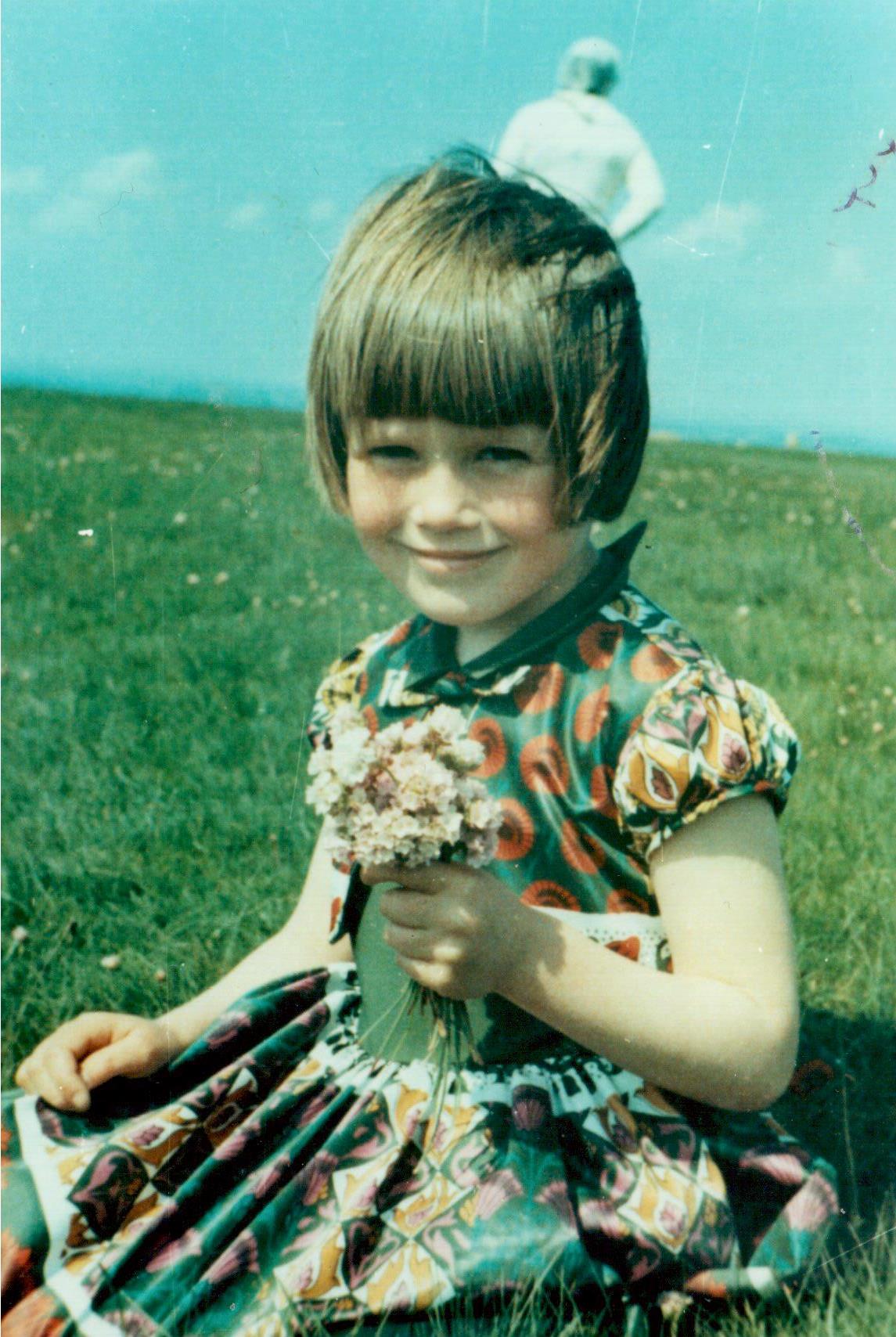
It is 50 years since Jim Templeton took the famous image of a figure in a space-suit hovering behind his daughter on the Solway Marshes in the English Lake District.

The Solway Spaceman photograph, taken from a print supplied by Jim Templeton in 2001

The Solway Spaceman photograph, taken from a print supplied by Jim Templeton in 2001 (copyright Jim Templeton)

Since that family outing in May 1964 when the figure – dubbed the ‘Solway Spaceman‘ – was captured on Jim’s Zeiss Pentacon camera the image has resisted all attempts to explain it.

Jim, who died in 2011, saw nothing unusual when he took the photo of his 5-year-old daughter Elizabeth, as she sat on grass holding a bunch of sea pinks.

But when he took the photo for development at his local chemist the assistant told him it was shame the best image had been ‘spoiled by the man in the background wearing a space suit’.

Jim worked for Cumbria’s fire service and immediately sent the photo for analysis at Kodak and by Carlisle CID. Soon after it appeared on pg 1 of the Cumberland News the image made headlines across the world. Jim’s family were inundated with letters from people who identified the ‘figure’ as a angel, an alien and a ‘spirit form’.

The mystery grew because the photo was taken from a position looking towards the Chapelcross nuclear power station, across the Solway Estuary.  At the time MoD manufactured Blue Streak rockets at RAF Spadeadam, near Carlisle, and of course the NASA Apollo programme was in full swing across the Atlantic.

In the summer of 1964 Jim said he was visited by two mysterious ‘men from the Ministry’ who claimed they worked for the government. In a scene that could have been taken from the film Men In Black the men referred to each other by numbers and drove a black Jaguar car.

The full story – and the police and MoD investigations that followed – will be told in my new book Britain’s X-traordinary Files published by Bloomsbury in September. A summary can be followed in my case files pages here and BBC Cumbria have published a 50th anniversary feature on the mystery here.

Since 1964 there have been many attempts to explain the photograph as a hoax but none have succeeded and the most recent study, published by Rational Wiki, suggests the ‘spaceman’ is actually Jim’s wife, Anne.

This theory says the model of camera used by Jim only revealed 70% of what the lens actually captured.

That being the case, he failed to notice his wife – who was standing behind him at the time – walk into the shot and take her place in history. Another photograph from the outing shows Mrs Templeton wearing a blue dress which has overexposed to white. When manipulated in photoshop it resembles the colour of the ‘spaceman’.

But Jim and his wife remained adamant that she could not have been the figure in the photograph.

Whatever the explanation the image remains one of the most puzzling examples from the gallery of anomalous photography.

Posted in Uncategorized | Tagged , , , , , , , , , , , , , , , , , , , , , , , | 8 Comments

On Tour With The Angels

August-September marks the 100th birthday of ‘the greatest urban legend of the 20th century’ – The Angels of Mons.

Flyer for the Folklore Society Legendary Weekend in September 2014

Flyer for the Folklore Society Legendary Weekend in September 2014

The inspiring tale of desperate Tommies saved from annihilation by the Kaiser’s troops via the intervention of shining angel warriors – led by St George wielding a flaming sword – was believed by millions during the Great War.

The Angels of Mons went on to inspire countless newspaper stories, books – including my own account of the legend, published in 2004 – films and even sheet music.

This and other legends of the 1914-18 war are set to be re-told and debated once again as the centenary of the battle of Mons approaches.  In August the Belgian city will play host to an international event to commemorate the outbreak of WW1 at the war cemetery and nearby battlefield.

Rumours about phantom bowmen, saints and angels protecting Allied troops spread to the Home Front after author Arthur Machen published a short story in the London Evening News in September 1914.

I will discuss the respective roles played by Machen and his contemporary Edgar Rice Burroughs in a series of talks at conferences and literary festivals to mark the centenary of the battle and the legend it spawned. This will include some new revelations about the possible inspiration for the story and those who claimed to have seen the ‘angels’ and bowmen of Mons.

In June I will be presenting my latest research on the Mons legend in Prague at the annual conference of the International Society for Contemporary Legend Research (ISCLR). Scholars of urban and ‘contemporary legend’ from across the globe will be sharing the latest research in the field at this wonderful six-day event in the capital of the Czech Republic.

Nearer the anniversary I will be speaking about The Angels of Mons and other legends of the war at The Folklore Society‘s legendary weekend at Chatham, Kent, on 6-7 September.  With the timely theme of ‘War in Legend and Tradition‘ this conference will explore songs, ghosts, omens, rumours and rituals from the last two millennia of conflict.

‘War in Legend and Tradition’ will be held in the Napoleonic-era Fort Armherst and organiser Jeremy Harte is keen to hear from anyone who can contribute to the military theme – folklorists, veterans, storytellers, re-enactors, military historians or ‘poor bloody infantry’. For more details contact Jeremy via the Folklore Society website here.

And later in the year I will present an illustrated lecture on the Mons legend at the Off The Shelf literature festival in my home city of Sheffield before taking the angels of Mons on tour.


Posted in Uncategorized | Tagged , , , , , , , , , , , , , , , , | Leave a comment

Happy birthday to ‘The Thing’

2014 marks the 50th anniversary of the Warminster UFO mystery that transformed the small Wiltshire market town into a centre of pilgrimage for flying-saucerers.

From the Christmas of 1964-65, if local journalist Arthur Shuttlewood can be believed, the town was virtually under siege from ‘The Thing’, a terrifying airborne sound.

Soon afterwards visits from flying saucers and nocturnal lights became as regular as clockwork.

Shuttlewood’s updates for the weekly Warminster Journal became headline news in the Daily Mirror and other London tabloids.

From 1966 every weekend and bank holiday, UFO watchers camped out on Cradle Hill, which borders the British Army firing range on Salisbury Plain, to watch the space people fly past.

By the 1970s interest began to wane and when I visited the town in 2006 there was no mention of the ‘mystery’ in the town’s Tourist Information literature.

But times are a’changing thanks to Warminster stalwart Kevin Goodman, who revived the annual August bank holiday skywatch tradition in 2007.

As a teenager Kevin made regular trips from his home in the West Midlands to skywatch at Warminster and had a number of extraordinary experiences there.

Kevin now runs  – with Steve Dewey – the Warminster UFO website, dedicated to the legend, that is linked to a Facebook page.

In February this year, when BBC2’s peripatetic antiques show Flog It! visited Warminster, presenter Paul Martin made the town’s UFO legend the centrepiece of the show.

Kevin will speak about ‘the Warminster Mystery at 50’ at the 2014 BUFORA Conference, to be held in the Glastonbury Assembly Rooms ,on Saturday, 30 August. Tickets can be booked here.

Afterwards pilgrims can join a coach trip to Cradle Hill and take a trip back to the good old days of UFO-ology.

Posted in Uncategorized | Tagged , , , , , , , , , , , | Leave a comment