We See Everything – even Flying Saucers

September 2022 marks the 70th anniversary of an unexplained sighting that confounded the Royal Air Force and led the British government to ‘take the UFO seriously’ for the first time.
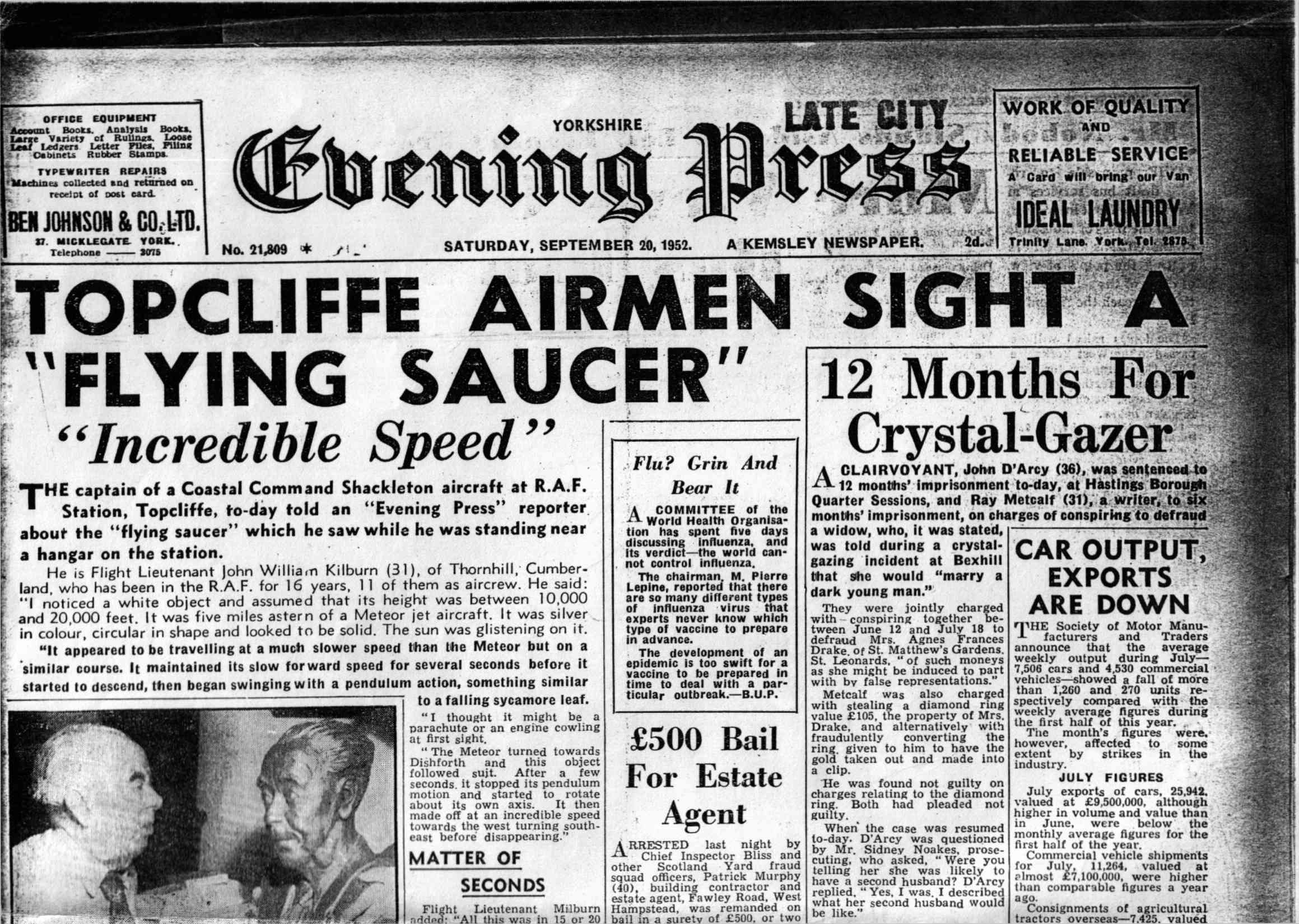
The RAF Topcliffe sighting made the front page splash for the Yorkshire Evening Press, 20 September 1952 (image: David Clarke)

Just before 11 am on Friday, 19 September 1952 a group of ten officers and national servicemen from 269 Squadron, observed ‘a perfect flying saucer’ from the runway at RAF Topcliffe in North Yorkshire as it followed a Meteor jet approach nearby Dishforth aerodrome.

The sighting took place during a NATO exercise, Mainbrace, that simulated an attack on Western Europe by the Soviet Union.

Mainbrace was a 13 day exercise that involved the armed forces of eight countries, More than 150 warships and hundreds of aircraft took part.

Aircrew from the RAF’s long range Shackleton patrol bomber squadron 269 were waiting for orders at Topcliffe a former WW2 Bomber Command airbase near Thirsk. One of the officers, R.N. Paris, noticed a white object in the sky. It was at a height of 10-20,000 feet five miles astern of the descending Meteor.

According to a statement made by Flt Lt John Kilburn to Air Ministry: ‘…the object was silver in colour and and circular in shape’ as it followed the Meteor but then began to descend ‘swinging in a pendular motion…similar to a falling sycamore leaf’.

Their immediate thought the ‘object’ was a parachute or a piece of engine cowling that had fallen from the jet aircraft. But as the Meteor turned towards Dishforth the circular object suddenly halted it descent and followed, rotating along its own axis.

‘Suddenly it accelerated at an incredible speed towards the west turning onto a south-easterly heading before disappearing,’ Kilburn reported, continuing: ‘All this occurred in a matter of fifteen to twenty seconds. The movements of the object were not identifiable with anything I have seen in the air and the rate of acceleration was unbelievable’.(TNA AIR 16/1199).

On Saturday 20 September the story made headlines in the local and national media. The Yorkshire Evening Press newspaper carried news of the ‘saucer’ sighting across its front page. Journalists were allowed to interview the airmen and the RAF was forced to admit the incident was under investigation by its ‘special branch’. On the following day the London Sunday Dispatch splashed with ‘SAUCER CHASED RAF JET PLANE’ and asked: ‘What Intruded into Exercise Mainbrace?’

Headline from the London Sunday Dispatch 20 September 1952

Soon the RAF’s top brass at Air Ministry were asking the same question…

A flash signal reporting the ‘flying saucer’, was sent to Air Ministry London from RAF Pitreavie Castle, MHQ and HQ Coastal Command. It was seen by Ralph Noyes, Private Secretary to the Vice Chief of the Air Staff, Sir Ralph Cochrane who, in 1988, recalled his bosses ’embarrassed unease, widely shared by the operations staff, that “our own people” had begun to fall for “that saucer nonsense”‘.

Nevetheless the signal, preserved at the UK National Archives, contains a hand-written instruction from the Wing Commander in charge of Ops (Air Defece) to ‘ask PA [personal assistant] to open a folder “Unidentified Aircraft or Objects reported to Air Ministry” (TNA AIR 20/7390).

According to the memoirs of Captain Ed Ruppelt, head of the US Air Force’s re-launched UFO project Blue Book, it was the Topcliffe/Mainbrace incident that ’caused the RAF to officially recognise the UFO’ (Ed Ruppelt, The Report on Unidentified Flying Objects, New York: Doubleday 1956, p196).

So the Topcliffe incident instigated the Air Ministry’s UFO desk that began its collection and analysis of data in 1952 and continued in many different guises for 57 years until its closure in 2009.

Sadly apart from the Air Ministry signal and a file of letters from the public collated by the station commander at RAF Topcliffe, few traces of the Air Ministry investigation have survived at The National Archives.
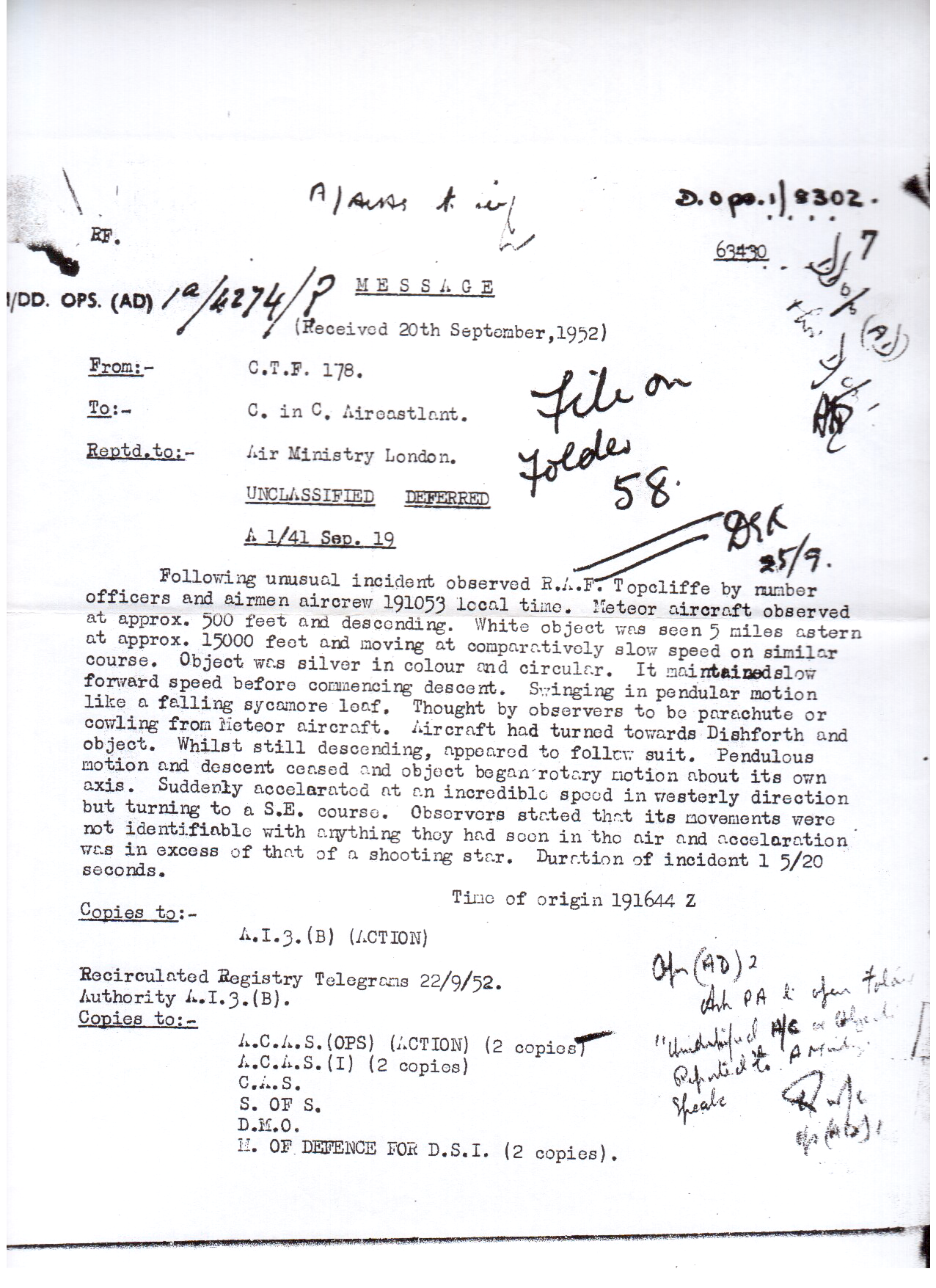
Signal from MHQ to Air Ministry London reporting RAF Topcliffe sighting (TNA AIR 20/7390)

In 1951 the Ministry of Defence closed the Flying Saucer Working Party, at a meeting attended by H. Marshall Chadwell, assistant director of the CIA’s office of Scientific Intelligence.

It concluded that all sightings could be explained as misperceptions, hoaxes and optical illusions – including those reported by RAF test pilots.

Their top secret report was used to brief Prime Minister Winston Churchill in the summer of 1952 following a massive UFO flap over Washington DC that made headlines across the world. It also led the CIA to take a deep interest in the potential of the UFO phenomenon for ‘psychological warfare operations’.

In 2001 I used the Freedom of Information Act to obtain a copy of a memo written by Chadwell dated December 1952 that refers to the ‘Yorkshire incident’ in a summary of British activity ‘in the field of UFOs’.

It reveals that the Topcliffe sighting was still under investigation by ‘a standing committee on flying saucers’ led by Dr (later Professor) RV Jones who was Chadwell’s opposite number in the British MoD.

RV Jones had a long connection with unexplained aerial phenomena that began in WW2 and its aftermath when, as intelligence officer for the Air Ministry, he was called upon to investigate the wave of ‘ghost rocket’ sightings in Scandinavia and parts of occupied Europe.

He was appointed as MoD’s Director of Scientific Intelligence by Churchill earlier that year and the signal from MHQ includes two copies of the report for Ministry of Defence DSI – Jones’s department of scientific intelligence.

The CIA’s H. Marshall Chadwell said the saucer had been observed by ‘high officials of the RAF in London’ who had been invited ‘to some sort of demonstration’ as well as RAF pilots. This might refer to the 12th anniversary of the Battle of Britain that was underway in Yorkshire and other parts of the UK from the 15th to the 20th of September, 1952. Aerobatic displays were flown by jets and older WW2 aircraft over Yorkshire towns and cities during Exercise Mainbrace.

‘So many people saw it [the saucer] that many articles appeared in the public press,’ the CIA noted. ‘This is disturbing to [Dr] Jones because he realises that the creation of the correction of public opinion is a part of his responsibilities’.

A follow-up article published by the Yorkshire Post in November 1952 revealed the RAF’s new UFO unit had failed to identify or explain the Topcliffe UFO. It also included the intriguing detail that ‘three aircraft captains with many years flying experience all saw the object’. This may suggest the object was also observed from the air, possibly by the pilot of the Meteor, in addition to the Shackleton crews on the ground. The sparse records that have survived do not throw any light on this intriguing admission – except for one item.

The single surviving reference to the Air Intelligence study of the Topcliffe sighting emerged in 1998 when MoD UFO records from 1967 were opened at The National Archives under the old 30 year rule.

One file contains a memo from a desk officer, John Dickison, who worked for the Defence Intelligence branch DI55. Dickison was based at RAE Farnborough and he that took over responsibility for UFO investigations from former Air Ministry tech intelligence branch earlier that year.

He had been asked to examine surviving intelligence files on UFOs from 1950-52 following a Parliamentary Question about UFOs from a former RAF pilot turned MP.

Dickison reported back that the ‘Topcliffe-Meteor incident, which occurred during the NATO Exercise Mainbrace’ was ‘typical of reports about such aircraft at that time’. He continued:

‘As regards the particular incident the “object” only appeared to come from the aircraft [Meteor jet]. There is no specific evidence from the files examined so far, that the object tracked or came from the aircraft. In fact, the trajectory of the apparent object was not established in absolute terms and thus typical questions such as true range have not been answered’. (TNA AIR 2/18117)

Since the early 1960s questions about the contents of these early intelligence files on UFOs, have been swatted away by MoD. The standard response is that, since 1967, records on UFOs were destroyed at five yearly intervals so nothing before 1962 had survived.

But as Dickison’s memo was written in 1967 and was based upon recently retrieved intelligence files dating from 1951-52, it would seem MoD was either being economical with the truth or it has been extremely careless with its record keeping.

The Operations Record Book of 269 Squadron throws no light on the UFO incident. But it does add a wry comment on its officer’s new found fame:

On the squadron’s arrival back to Ballykelly pinned up in the crew room was a very neat sketch of the squadron badge of arms. In the place of the contact charge – a galleon in full rig – an airborne NAAFI saucer was embellished and the motto added to – Omnia Videmus – We See Everything – even Flying Saucers…this was a small endowment left to the squadron by 209 Squadron who had used our buildings during Mainbrace. It referred to the memorable morning when six “reliable witnesses” of the squadron saw an airborne saucer over Topcliffe” (TNA AIR 27/2674).

‘…

Posted in Uncategorized | Leave a comment

The Calvine UFO photograph – revealed

Read the full story of how I found the most famous UFO photo in the world in my exclusive story published by The Daily Mail here. And follow the breaking story over on UAPMedia UK.

After thirty years immersed in the world of UFOlogy I had grown cynical after viewing hundreds of unconvincing photographs and films.

Most were blurred, grainy and out-of-focus shots of what could have been frisbees, streetlamps or even seagulls.

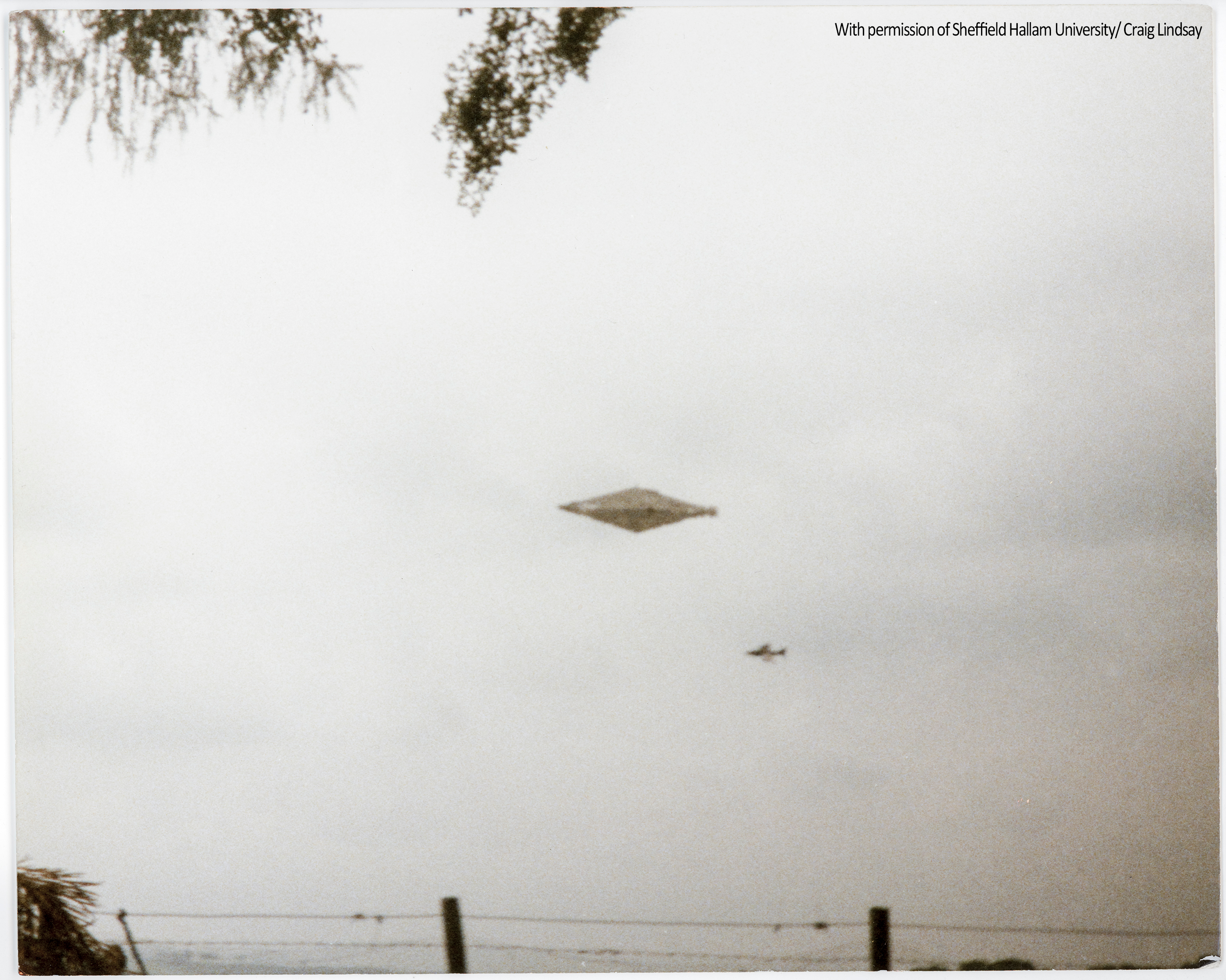
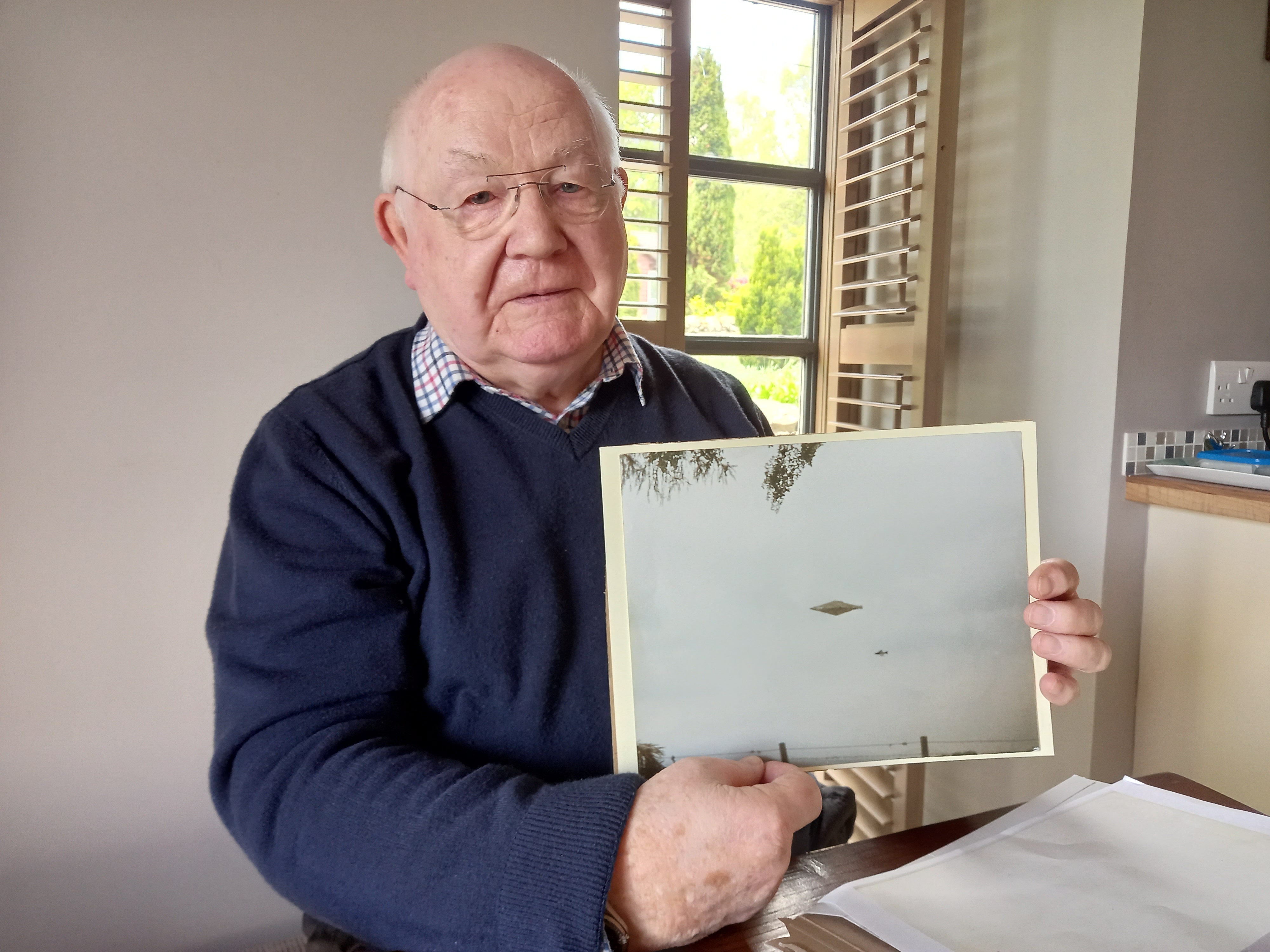
But when retired RAF officer Craig Lindsay showed me the only surviving print of the Calvine UFO photo he had kept safe for more than three decades I knew I was looking at something exceptional.

The ‘best’ image from the six UFO photographs taken at Calvine in Scotland at approx 9pm on Saturday 4 August 1990 (with permission of Sheffield Hallam University/Craig Lindsay)

My quest for the truth behind this photograph began back in 2009 when I was curating the release of thousands of once secret MoD UFO documents at The National Archives.

One of the files contained a poor-quality photocopied drawing of a UFO with a Harrier beside it, produced by the RAF’s photographic experts in 1990.

There was also a briefing prepared for Defence ministers in Margaret Thatcher’s government should they need to answer questions when the story broke in the Press.

Yet it never did and the file revealed nothing more about the photograph or the man who took it.

As an investigative journalist this mystery was too intriguing to ignore.

Little did I know then, however, that it was soon to become the longest and most frustrating investigation I have ever conducted. In the summer of 2021 I published the results of research in my Calvine case file update.

But even now, one year later and with one of the original missing photograph found, many questions still remain unanswered.

Former RAF Press Officer Craig Lindsay holds a first generation print of the Calvine UFO in May 2022 (Image Copyright David Clarke 2022)

Wherever I searched for answers, I found insiders blocking my inquiries.

For example, the MoD and The National Archives have refused to remove the black ink that covers the name of the photographer in the Calvine file, claiming it would be an intrusion into his privacy.

Yet in 1990, within days of his sighting, this man had sent his negatives and personal details to Scotland’s best-selling tabloid, so he was not shy of publicity at that time.

Even more baffling no one at The Daily Record remembered the story clearly or could explain what had become of the negatives that remain missing to this day.

A week spent knocking on doors in Pitlochry, the nearest tourist town to Calvine and gateway to the Scottish Highlands, also failed to develop any new leads.

Inquiries at the hotels where I knew the two young witnesses had worked likewise drew a blank. No one remembered the story or had even heard rumours about it.

Had the original story been spiked by a D-Notice, a gagging order based on national security concerns, served on the newspaper by the MoD?

While this might sound like something from TV’s The X-Files research by UFOlogist Matthew Illsley revealed that the Record’s editor, the late Endell Laird, had been a member of the MoD’s D-Notice committee at the time.

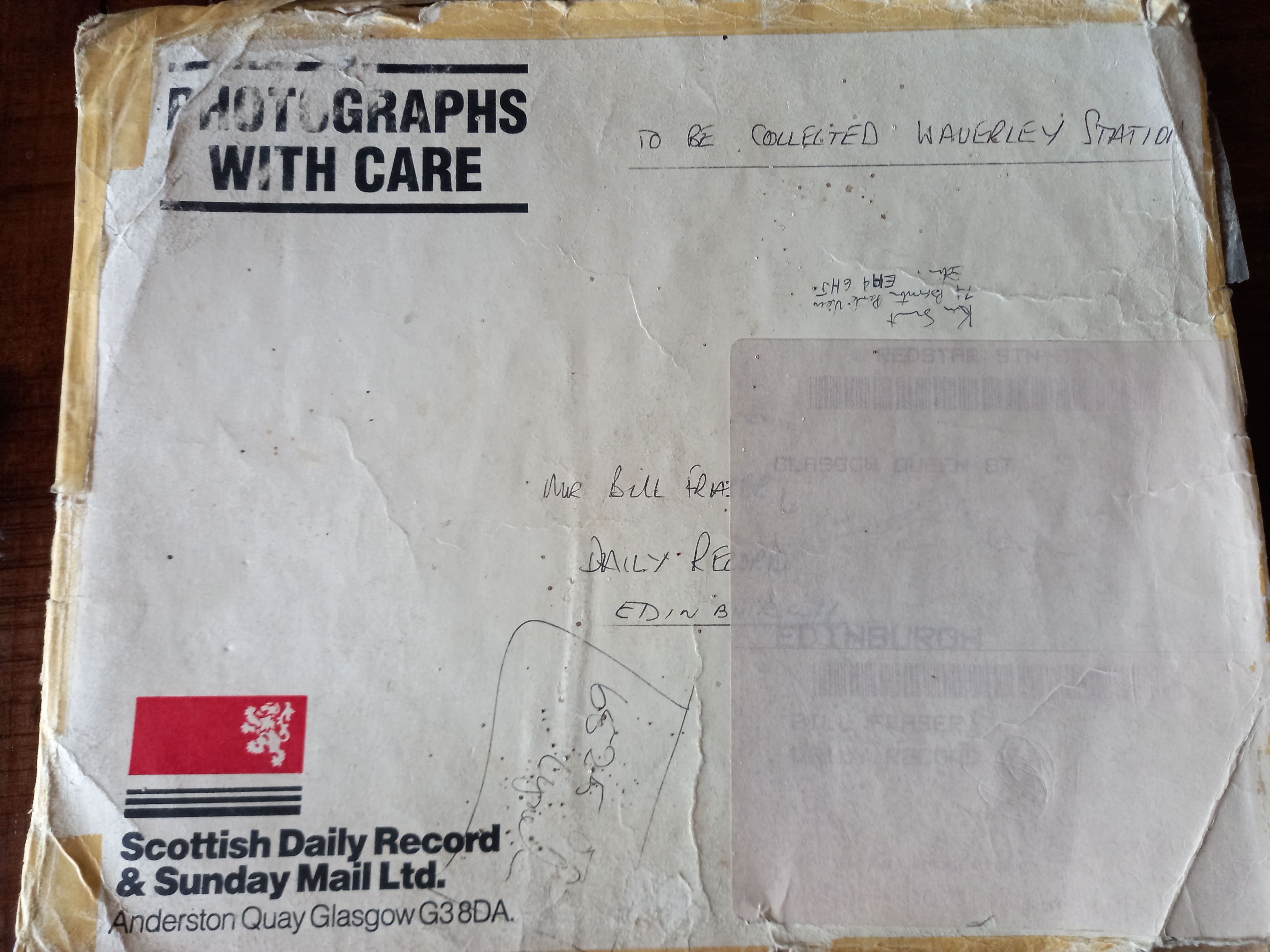
The original envelope that was used by the Daily Record to send the UFO image to the RAF in 1990
(Image copyright David Clarke 2022)

Was this just a coincidence?

And is there a link between the date of the sighting and the invasion of Kuwait by Iraqi forces that happened two days before the Calvine incident?

Thirteen years and many dead ends later a lucky break led me to call Craig Lindsay who, it turned out, had kept a genuine, first-generation print of the ‘best’ photograph.

He said: ‘I have been waiting more than 30 years for someone to call me about this story…and you are the first person to do so.’

In his own words, it is ‘either an extremely clever hoax or it shows “the real thing”’

But if it is ‘the real thing’ was the craft built by humans in a secret hangar somewhere on Area 51?

Or could it have come here from another planet?

Ex-MoD desk officer turned UFO pundit Nick Pope has described the Calvine image as ‘the most spectacular UFO photo ever sent to the Ministry of Defence’.

But could it be a very elaborate fake? Expert photographic analysis by my colleague Andrew Robinson, senior lecturer in photography at Sheffield Hallam University, suggests not.

He says: ‘My conclusion is that the object is definitely in front of the camera, i.e. it’s not a fake produced in post production, and its placement within the scene appears to be approximately halfway between the foreground fence and the [Harrier jet] in the background.

‘Could this be a kite or a radio controlled model? It could be but it would have to be a very large kite/model, at least 20-30m [65-98 ft] long if not longer’

In June 2021 the Pentagon released its long-awaited report on what it now calls UAPs or unidentified aerial phenomena after a spate of similar sightings and footage taken by US Navy pilots.

The new US UAP Task Force listed five identified categories that most sightings, when resolved, are likely to fall into. One of these is ‘classified programs’ developed by the US government.

The report says ‘we were unable to confirm, however, that these systems accounted for any of the UAP reports we collected’.

When I last published an update on this story I concluded it must be a hoax. But now I am convinced the Calvine UFO photograph shows one of these US classified ‘Black Project’ programs.

There is evidence that the Americans, and possibly also the British government, have found it useful to ‘keep the UFOs flying’ because they provide a useful cover for their own covert military activities.

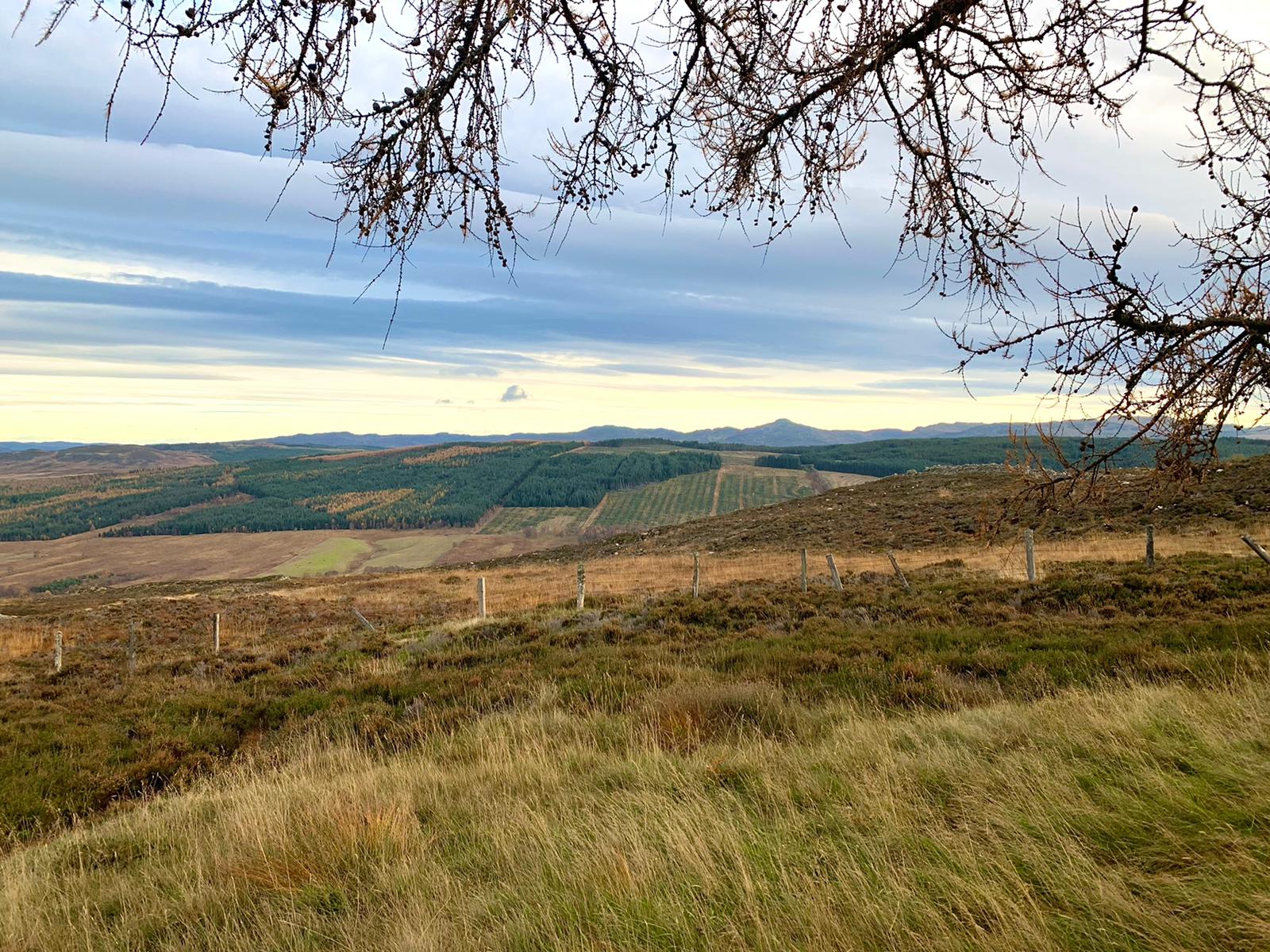
View from Struan Point near Calvine, Perthshire, showing the wire fence and overhanging trees.
This is the location where we believe the photograph was taken in 1990 (Image Copyright Giles Stevens 2022).

But in this case their cover was blown by two young men who were in the wrong place at the wrong time.

The Ministry of Defence must now explain to the public why, if there are no such things as UFOs, how they can justify keeping their identities secret for a further 54 years.

And MoD also should explain what happened to the negatives and their file on this case – otherwise they are simply adding further grist to the mill of the conspiracy theorists who believe the authorities are hiding ‘the truth’ about visits to Earth by aliens.

I am open-minded about the possibility that intelligent life exists elsewhere in the universe. But I remain unconvinced that it has ever visited Earth.

The Calvine UFO photograph is in my opinion the best image of an unidentified flying object ever taken.

But as Dr J Allen Hynek, consultant to the USAF’s former UFO Project Blue Book once said, ‘unidentified to whom?’

Note: the original Calvine print and related documents were donated to my legend archive at Sheffield Hallam University Library Special Collections in July 2022.

Copyright David Clarke 2022

Posted in Uncategorized | Tagged , , , , , , , , , , , , , , , | 11 Comments

New claims in film by the ‘lad who photographed flying saucers’

Alex Birch whose photographs of UFOs puzzled experts on both sides of the Atlantic has released a film about his experiences – that he claims included meetings with the British royal family and a phone conversation with JFK.

In Beyond Perception Sheffield-born Alex says he attended private meetings with Prince Philip, who died age 99 in 2021 and Lord Mountbatten of Burma who asked the then 14-year-old Alex to call him Dickie. Both men were known for their fascination with the UFO mystery at that time.

But in the new film Alex, now 74, also claims he took part in a transatlantic telephone conversation with President John F Kennedy in 1962 after his photo of a fleet of flying saucers made news headlines across the world.

In the 30-minute film Alex says a military car collected him and his father from their home near Sheffield from where they were taken to a US military base. On arrival they met USAF officials and the base commander. During the visit he was taken to an adjoining room where he was put through to a man he believes was JFK.

The man quizzed Alex ‘asking if there was any visible markings on the objects, also how high were the objects and how big they were and many other questions’. He says Kennedy was concerned the Russians had ‘secret weapons and were already exploring space’. Kennedy was assassinated in November 1963 after launching NASA’s Apollo space programme that put the first men on the moon.

Shortly before the call Alex, then 14 years old, had travelled to London with his father where his black and white photograph and Box Brownie camera were examined by officials at the Air Ministry. A MoD file documenting the meeting was released at The National Archives in the 1990s.


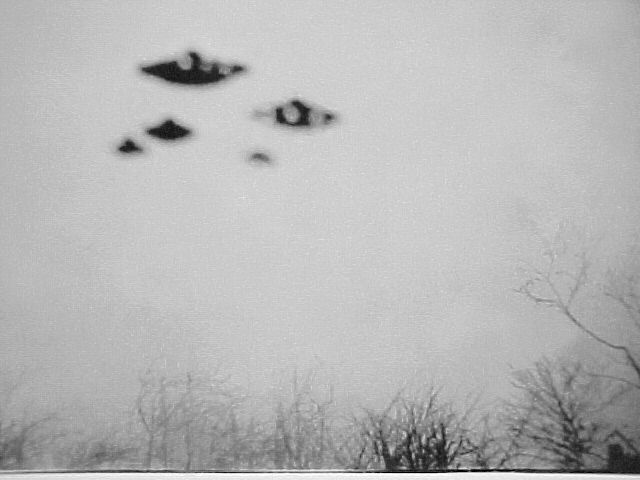
Alex Birch’s photo showing a fleet of UFOs over Mosborough, near Sheffield, in March 1962 (Copyright A. Birch)

After the media furore surrounding this photograph Alex faded from the public eye. But flying saucers, and UFOlogists, continued to haunt him. He was taunted at school and everywhere he went he was known as ‘the lad who had photographed flying saucers.’

So in 1972, when he was 24 years old, he contacted the Daily Express and confessed it was a hoax. He even appeared on TV with the pane of glass on which the ‘saucers’ had been painted. For ten years he had fooled his family, friends and even the Air Ministry who had them tagged as ‘ice crystals’.

The ruse, for according to Alex it was a ruse, worked. Alex says he knew the photo was genuine but his manipulation of the media removed the heat; interest in him diminished and he was able to concentrate on building a career and supporting a family. But his interest in photography remained and over the years he became an accomplished practitioner, entering and wining numerous competitions.

Meanwhile his iconic flying saucer photograph continued to be reproduced in books and magazines worldwide. In 1998 Alex, who no longer possessed a copy of the original negative, decided to step back into the public spotlight to reclaim his own copyright on the image. He also wanted the world to know the truth: he really did see, and photograph, flying saucers in 1962.

After a short flurry of media and UFOlogical interest, his U-turn was again quickly forgotten. Alex didn’t care who believed him and, now a grandfather, he believed his adventures in UFOlogy were now a thing of the past.

Until Tuesday, 27 January 2004. On that evening Alex, now 55, was sitting in his bungalow watching TV with his wife when it began snowing heavily. At the time Alex was trying to think of a suitable photograph to enter in his local photographic society’s competition and this unexpected snowfall made him think he might get an unusual night time shot.

Leaving the house at 9.15 pm, without even telling his wife, Alex drove through heavy snow to the market town of Retford, in rural Nottinghamshire, where he parked in the square. The thick snow and the relatively late hour meant the square was completely deserted and silent. Alex spent some time taking a variety of photographs of the square, road and buildings that were covered in snow and reflecting lights from lampposts and buildings. He was using 35mm Fujia Sensia 200ASA reversal film (a slide film).

After using the roll of thirty six frames Alex returned home and shortly afterwards sent the film for processing. When the slides were returned he spent some time looking at them on a small battery operated viewer, trying to identify a suitable slide for entry in his local photography club’s competition. He found three shots that were perfect and then noticed an odd image on one of the slides. To his amazement when he looked closer he saw a UFO, a saucer shaped UFO at that, just to the side of Retford Town Hall. The Town Hall clock fixes the image in time at 23.08.

UFO? Retford, Nottinghamshire, 27 January 2004 (Copyright A Birch)

Alex was naturally keen to tell us about his new photograph. We were, naturally, skeptical. After all, the chances of someone taking a photograph of a genuinely anomalous UFO once are massive. To do so twice in a lifetime would be, well, Fortean. We recalled the furore over Alex’s 1962 photograph, his 1972 confession and his subsequent revelation that it was genuine after all. What was going on?

Alex wasn’t going to let the problems which plagued his 1962 photograph affect this new one and he decided to eschew any publicity. He just wanted to know what he had caught on film. The first time we saw the new UFO image was on a copy of a slide he sent to us.

We thought it was obviously a lens flare; there are numerous lights on lamps and buildings and even though we couldn’t prove it, a lens flare of some kind seemed to be the only logical conclusion. Most tellingly Alex did not see the object whilst taking the photographs and it is axiomatic that an image which is noticed only after processing is almost always a bird, lens flare, camera or film fault. Alex disagreed and told us he firmly believed the image on the film was of an object in the sky:  a real UFO.

Despite the prospect of fresh media attention and money from this photograph Alex wasn’t interested. He wanted to get to the bottom of it privately and, rather than trust the photograph to the care of the UFO community, of whom he has a profound mistrust, he set about investigating it himself.

Sheffield University’s Department of Physics and Astronomy ruled out any celestial or astronomical phenomena and local airfields confirmed there were no aircraft over Retford that night. He then took the slide to the Kodak Laboratories in Lincoln. Their technical analysis ruled out any possibility of lens flare, double exposure, drying stains, re-touching or a host of other possibilities. Indeed, the Kodak analysis found that the UFO image had the same density pattern, colour and grain as the surrounding picture. This suggested to the Kodak analysts that whatever ‘it’ was, it was in the sky when photographed. Robert Smith of Kodak’s labs went so far as to write on the back of the photograph, ‘This image has not been altered or manipulated in any way.’

Then he tried his old bete noir, the Ministry of Defence. After several phone calls to the MoD’sWhitehall building Alex made an appointment to see the UFO desk officer, Linda Unwin. She suggested a meeting and told Alex that ‘defence experts’ would be interested in viewing the slide.

A meeting was duly arranged for 9 March 2004 and Alex asked Andy Roberts to accompany him. It is highly unusual for a UFO witness to be interviewed by MoD personnel and even more unusual for them to be invited to visit the MoD Main Building. The last time this had happened was in 1962 when Alex, then a schoolboy, visited the Air Ministry with his father and allowed experts to examine his Box Brownie camera and his other picture of ‘flying saucers.’

The 2004 visit did not go to plan. Alex and Andy were met in the reception area by Linda Unwin and a colleague, who seemed to be unaware of the promised ‘meeting’ or the possibility of defence experts viewing the slide. She was happy to take a copy for analysis, but Alex and Andy got no further than the ornate reception area. Alex believes the meeting was cancelled because he had not told them he was bringing guests (his son in law was also present).

In a follow-up letter Unwin asked for a copy of the negative for scrutiny by a ‘defence imagery analyst.’ Using the Freedom of Information Act we discovered that a copy of the slide was sent by Unwin’s branch to the MoD’s Defence Geographic and Imagery Intelligence Agency (DGIA), based at RAF Brampton in Cambridgeshire. Experts there analyse aerial photographs and other military-sourced images for intelligence purposes. In this case, Alex was told that UFO photographs are ‘not within the normal course of work’ for the imagery experts ‘but [they] have agreed to fit this in around essential defence work.’

The Graphics and Digital Imaging Section completed their assessment on 2 August 2004. A scan at 2,400dpi allowed them to investigate ‘at greater magnification the structure of the anomaly’ but found no indication of reflections or lens flares. The brief report ends with these words: ‘No definitive conclusions can be gathered from evidence submitted, however, it may be coincidental that the illuminated plane of the object passes through the centre of the frame, indicating a possible lens anomaly e.g. a droplet of moisture.’

A page from the DGIA (JARIC) report on analysis of the Retford photograph (Crown Copyright)

Alex claims he has subsequently had other meetings and conversations with MoD personnel, but maintains that neither he nor they are any closer to resolving what he has captured on film. When we visited Alex in the spring of 2007 he was enthusiastic about his new photograph and remained convinced that, based on the evidence from Kodak and other experts, he had captured an unknown aerial object on film.

But now there was more. Alex had previously told us that he had, over the years, been subject to what can only be described as psychic phenomena. He had been plagued by poltergeists and bizarre audio and electromagnetic anomalies. Lights in the sky appeared to follow him around and on one occasion he had been struck by lightning. These phenomena had been witnessed by other members of his family who were happy to confirm it to us.

Alex was now telling us that there was something else unusual about his second saucer photograph. He had experienced flashbacks to that snowy night in Retford; flashbacks involving visions of a gigantic saucer hovering over the square. He also suspected there may have been a period of missing time.

Alex with his 1962 photo and Box Brownie camera (Copyright David Clarke)

What to make of all this? Is Alex a complete fantasist who has repeatedly tried to fool the media, UFO investigators and possibly his family for over 45 years? The simple fact is, we just don’t know. It would be easy to dismiss Alex as a hoaxer and a fantasist, partly because everyone ‘knows’ real UFOs don’t exist and partly because of his (later retracted) admission that he had hoaxed the 1962 photograph.

But no-one could prove exactly how – if – his original photo was hoaxed and no-one, not even the MoD’s imagery experts can say with certainty what is on the photograph he took on 27 January 2004.

Alex has thought long and hard before allowing his second photograph to be revealed to a wider audience. He is not interested in public exposure or in financial gain, although this does not rule him out as a hoaxer. He is only concerned that his stories are told factually and objectively. As skeptical forteans we have known Alex for more than 20 years and find him and his family to be completely normal, open and honest. We are perplexed. But there has to be an answer, now matter how prosaic or extraordinary. So what is it?

Speaking after the release of his film on YouTube and Vimeo, Alex told us:

‘Its basically a documentary which explains what happened within my life from early childhood regarding UFO’s and the paranormal. Although the doc only scratches the surface and there is much more to tell. I had to think long and hard about publishing certain things within the documentary film. I am now hardened towards the remarks of skeptics, trolls, and those who seek a living from defaming people, when in reality they know absolutely zero about me.’

Text copyright David Clarke and Andy Roberts 2022

Posted in Uncategorized | Tagged , , , , | 3 Comments

Canada’s UFO Files: book review

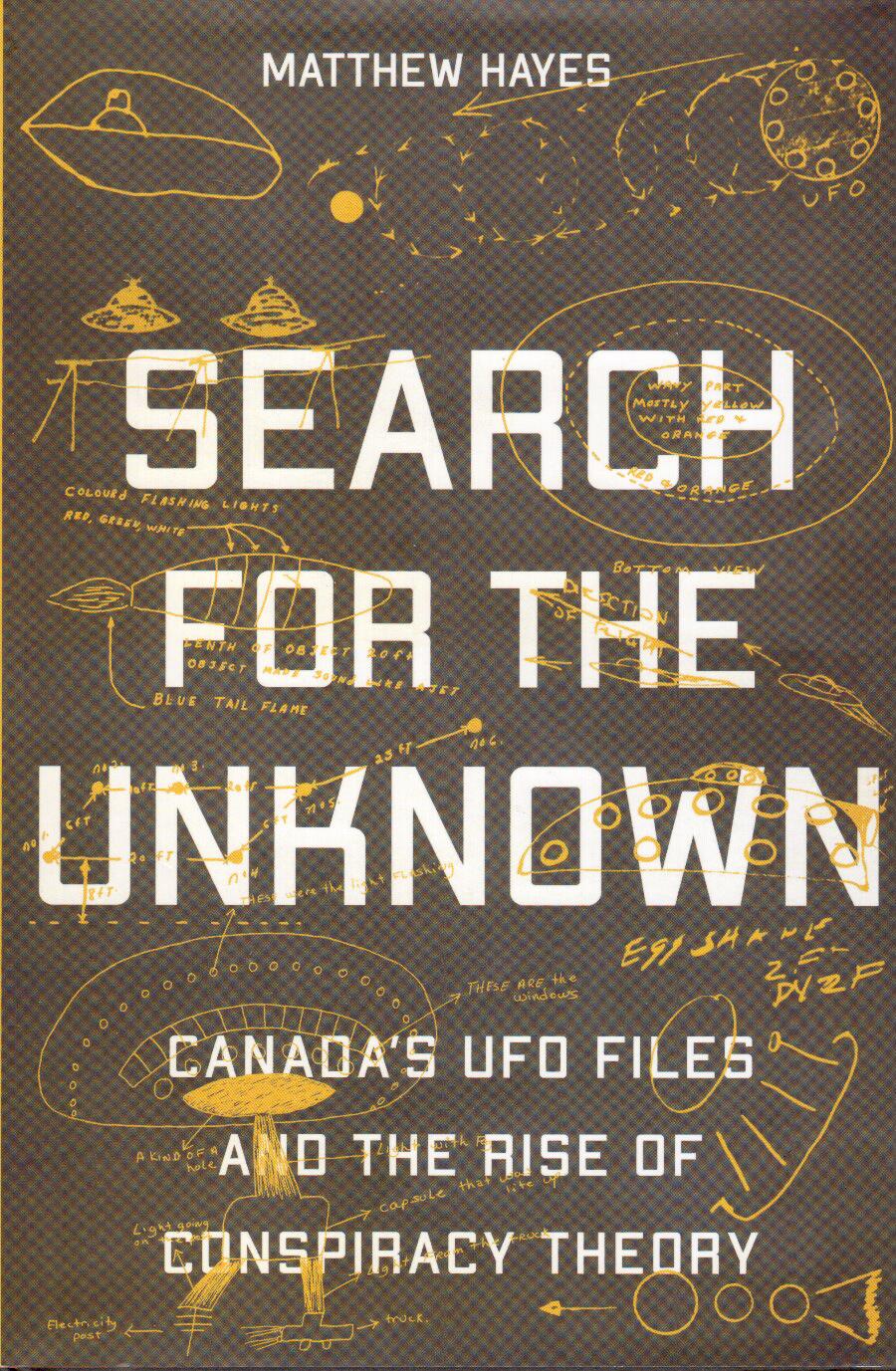
Search for the Unknown: Canada’s UFO files and the rise of conspiracy theory. Matthew Hayes. McGill-Queen’s University Press, 2022. Illustrated, index, 210 pages.

Cover of Matthew Hayes book on Canada’s UFO files

A readable academic summary of the highlights of the little-known Canadian government UFO archive that includes some unique insights into the origins of UFO-related conspiracy theories.

Matthew Hayes was inspired to write this book after visiting a virtual exhibition titled Search for the Unknown that was curated by Library and Archives Canada in 2005. This online resource appeared three years before the UK National Archives first began to make its own large collection of MoD UFO documents available online. It was one of the first that took advantage of what were at that time pioneering web-based technologies that allow remote users access and download original archive documents.

The Canadian UFO files include thousands of documents created by government agencies between 1950 and 1995. During those four decades responsibility for logging sighting reports was passed backwards and forwards among largely disinterested officials in the Department of National Defence and Transport, National Research Council and the Royal Canadian Mounted Police. In total the archive contains 4,500 sighting reports and more than 15,000 pages of related documents covering the four decades.

These figures are roughly half the number collected by the UK MoD for the same period, but Canada is a huge country and the geographical spread of reports reflect the fact that its population is concentrated in the large cities. Much like the UK the Canadians deferred to the United States who were investigating UFO reports via Project Blue Book. During the early part of the Cold War, Canada launched two overlapping UFO investigations, Project Magnet (1950-54) and Project Second Storey (1952-54). Few if any of the sightings examined by these projects appear to have been made by military sources and the vast majority originated from members of the public.

This book includes 21 examples of black and white UFO drawings from the files that Hayes compares these unfavourably with those I curated in 2017 for my book UFO Drawings from the National Archives. He says the UK drawings are ‘colourful, full of life and energy’ and powerfully communicate contrasting feelings such as fear and hope. But their North American counterparts are simply ‘interesting [and] serve more as accompaniments to the sighting reports’.

That is not to say the Canadian UFO files are dull compared to their UK collection. Indeed one chapter includes accounts of three ‘high strangeness’ cases reported during 1967 when the number of sightings tripled from 55 in the previous year to 169. This flap coincided with the country’s centennial year that saw the launch of a UFO landing pad in St Paul, a small town in Alberta. It was opened by the former Canadian Defence Minister, Paul Hellyer, who in retirement joined the UK’s Lord Hill Norton in the elite group of high profile advocates for ‘disclosure’ of what governments know about the UFO phenomenon. As defence minister Hellyer should have been aware his government was as clueless as to the nature of the elusive phenomenon as any other.

Nevertheless, the Canadian government had its own modest cast of believers in extra-terrestrial visitations. The best known of these was Wilbert Smith, an electrical engineer employed by the Department of Transport who for a short period in the 1950s managed to purloin funds for Project Magnet complete with a rudimentary observatory designed to track objects in the near atmosphere. Smith’s personal belief in a ET origin for UFOs aroused alarm and suspicion among his superiors who eventually shut down Magnet in 1954. But Smith’s most notable achievement was his contact with Dr Robert Sarbacher, a US physicist and defence consultant whom he met at a radio conference in 1950. Sarbacher allegedly told him that UFOs were real and that ‘the matter is the most highly classified subject in the [US] Government, rating higher even than the H-bomb’, a comment that became author and UFO advocate Timothy Good’s favourite quote. But as Hayes points out, details of the meeting are unclear and the ‘document’ used as evidence is actually a recollection of Smith’s interview with Sarbacher and therefore just an anecdote.

In summary, the Canadian UFO files are much like others that have been gradually opened to public scrutiny as a result of open government and FOI initiatives across the world. They contain many examples of low quality ‘lights in the sky’ and convoluted correspondence between persistent UFO enthusiasts, who believed the authorities were hiding something, and exasperated officials who tried their best to ignore and debunk claims as either hoaxes or misinterpretations of natural and man-made phenomena. When officials failed to provide satisfying answers this created an attitude of mutual distrust that created fertile conditions for anti-authoritarian attitudes and the creation of conspiracy theories.

Some readers may find this book plodding in places as the author (who teaches English and philosophy at a Canadian college) tries his best to negotiate the fine line between a popular subject and academic credibility. But those who stick with it will find much of interest in the chapter on close encounter cases. These include the baffling Falcon Lake incident from 1967 in which a metal prospector, Stefan Michalak, suffered what may have been burns to his stomach after he approached a landed cigar-shaped UFO near a remote lake in Manitoba. That year also saw Canada’s first recorded examples of crop circles, a decade before they arrived in the UK, when a series of four appeared in a cattle pasture in Alberta.

The third equally bizarre case is the Shag Harbour incident from Nova Scotia of 4 October 1967 that is often called Canada’s Roswell. This differs from most of the others as it was corroborated by members of the local Mounty detachment. They were inundated with reports of a lighted object that fell into the harbour near the small fishing community and, on reaching the site, saw a ‘dark object’ floating in the water. Searches were carried out by boat and helicopter but as no hard evidence was found the case remains unsolved. As in the UK and US the authorities, presented with physical evidence of something unknown, were left with no option but to investigate as best they could. But far from providing any smoking gun, the surviving papers reveal inertia and a failure to analyse hard evidence such as potential radiation traces left at the Falcon Lake UFO encounter.

To his credit, Hayes makes a serious effort to move the spotlight away from those who see and believe in UFOs to examine the motivations and reactions such experiences generated among the general public and the officials whose job it was to respond to their concerns. One striking outcome of these interactions is the emergence of a conspiracy-theory driven mindset that has become stereotypical of the modern UFO phenomenon.

Posted in Uncategorized | 2 Comments

Time-slipping beneath the Dark and Lonely Waters

‘I have heard one definition of haunting saying we are haunted by that which we cannot or cannot completely understand.’ These words of wisdom, spoken by England’s greatest living wizard Alan Moore open The Cult of Water, a dreamy, hypnotic sonic production by David Bramwell and Oddfellows Casino.

Six years in the making the album combines spoken word, field recordings, pastoral electronica and nostalgic psych-folk that will delight fans of The Haunted Generation.

Donald Pleasance’s scary voiceover from the 1973 public information film The Spirit of Dark and Lonely Waters neatly evoke David’s fear of being dragged deep beneath the surface by the river goddess, a theme that recurs throughout this watery odyssey.

This project first took form in 2017 as Dead Flows the Don, an episode in the BBC Radio 3’s experimental series Between The Ears. Itpremiered in the following year on stage as a candlelit performance at Brighton Festival mixing music, archive film, narration, ritual and animation.

David then embarked on a theatre and festival tour that included dates in Sheffield and Doncaster (Roman danum) both towns that grew alongside the mighty river Don.

Haunted by his 1970s childhood in Doncaster, David takes listeners on a journey to its source deep in the Pennine hills, in search of the pre-Christian goddess danu. For our ancestors, rivers were supernatural in origin and to cross or enter a river was to enter a portal to another world where the flow of time behaves differently. In Celtic Britain rivers formed boundaries between tribal territories and offerings of coins, swords and shields were cast into the waters to appease the spirits that, on occasions, dragged unwary trespassers to their deaths.

From the 19th century the Don was subjugated to serve the industrial revolution and in Sheffield the city’s steel industry adopted Vulcan, the Roman god of fire and forge, to represent power over the forces of nature as personified in the river. On occasions the Don has usurped itself, most recently in 2007 when the river overwhelmed the city centre and much like other vengeful river deities in folklore ‘the shelving slimy river Don’ was once believed, every year to take ‘a daughter or a son’.

Indeed, Sheffield-born musician Jarvis Cocker and his Pulp bandmate Russell Senior have spoken of occasions when they tossed coins into the Don to appease the spirit of dark and lonely waters that haunted the childhood imaginations of their generation.

David Bramwell’s time-travelling trip upstream that forms the centrepiece of The Cult of Water is book-ended by a startling incident that leaves both narrator and listener questioning the nature of memory and its interaction with the ebb and flow of time. It centres upon a childhood memory of a church spire peeking out from the depths of a Derbyshire reservoir.

At the height of the heatwave and drought of 1976, eight year old David joined a family excursion to the Ladybower Reservoir, a popular tourist attraction in the Peak District National Park, to see the drowned church and its tower.

A huge artificial dam was constructed here before the Second World War to provide drinking water for Sheffield and the surrounding towns. Derwent’s parish church held its last service in 1943 before parishioners were evacuated and the upper valley was flooded with millions of gallons of water. But the church’s distinctive pointy spire was left standing. At times of drought, it would slowly emerge from the waters that surrounded it. For years the isolated spire drew huge crowds of sight-seers, some of whom were keen to explore it when droughts allowed access. A news account from 1947 describes how ‘this year’s drought left it high and dry and thousands of people climbed the wooden staircase inside’.

Derwent Church’s distinctive spire haunt the photos and artwork for the booklet that accompanies the album illustrated by Pete Fowler, best known for his work with Super Furry Animals. The penultimate track follows David as he returns to the valley in search of the iconic spire that haunted his childhood. He cannot find it because there was no spire peeking above the surface of Ladybower in 1976.

The Cult of Water album cover (credit: David Bramwell)

A book by local historian Vic Hallam, Silent Valley, reveals how, three decades earlier, in December 1947, the Derwent Valley Water Board demolished the church tower using explosives.

‘When I mention this to my family at first there is silence,’ says David. ‘Then my dad says firmly: I remember. And we all do…We’re not alone; others saw it too’.

Among them are the family of Hilary Mantel, author of the Booker prize-winning novels Wolf Hall and Bringing up the Bodies. Mantel was born in Derbyshire in 1952 and family members lived in the area when the reservoirs were built.  

Unknown to David, Mantel also recalled being told in her childhood that ‘when the water was low they had seen the spire rising above the waters’ until she realised this could not be true.

In a BBC 4 interview from March 2020 Mantel cites the story as ‘very thought provoking’ in her own journey as a writer and truth-seeker.

‘I had believed implicitly that they were seeing what they said they were seeing,’ she said, adding: ‘Each individual acted in perfect good faith and yet passed on an accumulated untruth’.

This increased her skepticism, ‘especially of those things that we instinctively move towards and want to believe’. It also made her reflect – much like David Bramwell – on different layers of reality, the nature of time and how fact, history and myth can merge into one.

What did all these people, including David and his family see in 1976 and on other occasions? Was it some form of mirage, a shared vision or mass hallucination? Or is this another example of a false memory of the type identified by psychologists in many other perplexing incidences, such as those accounts of missing time that have often become transformed by the media into stories of abduction by aliens.

When I first heard David’s account of the missing church spire and compared it with that of Hilary Mantel it also reminded me of the phantom houses that are said to materialise on rare occasions before incredulous witnesses. Possibly the best known is the so-called Rougham mirage that has haunted a stretch of road in Suffolk for 150 years. On occasions passers-by have been stunned to see a red-brick Georgian mansion-house, complete with elaborate gardens, that vanishes on close inspection. The Fortean literature records examples of other phantom dwellings.

Alongside sightings of the phantom spire of Ladybower others have reported strange occurrences in the Derwent valley that are often described as time-slips. These include the sound of eerie church bells and organ music ‘coming from beneath the water’ where the village of Derwent once stood. According to author Wayne Boylan the sound is ‘sad and lonesome…and only snatches can be heard drifting across the still waters’.

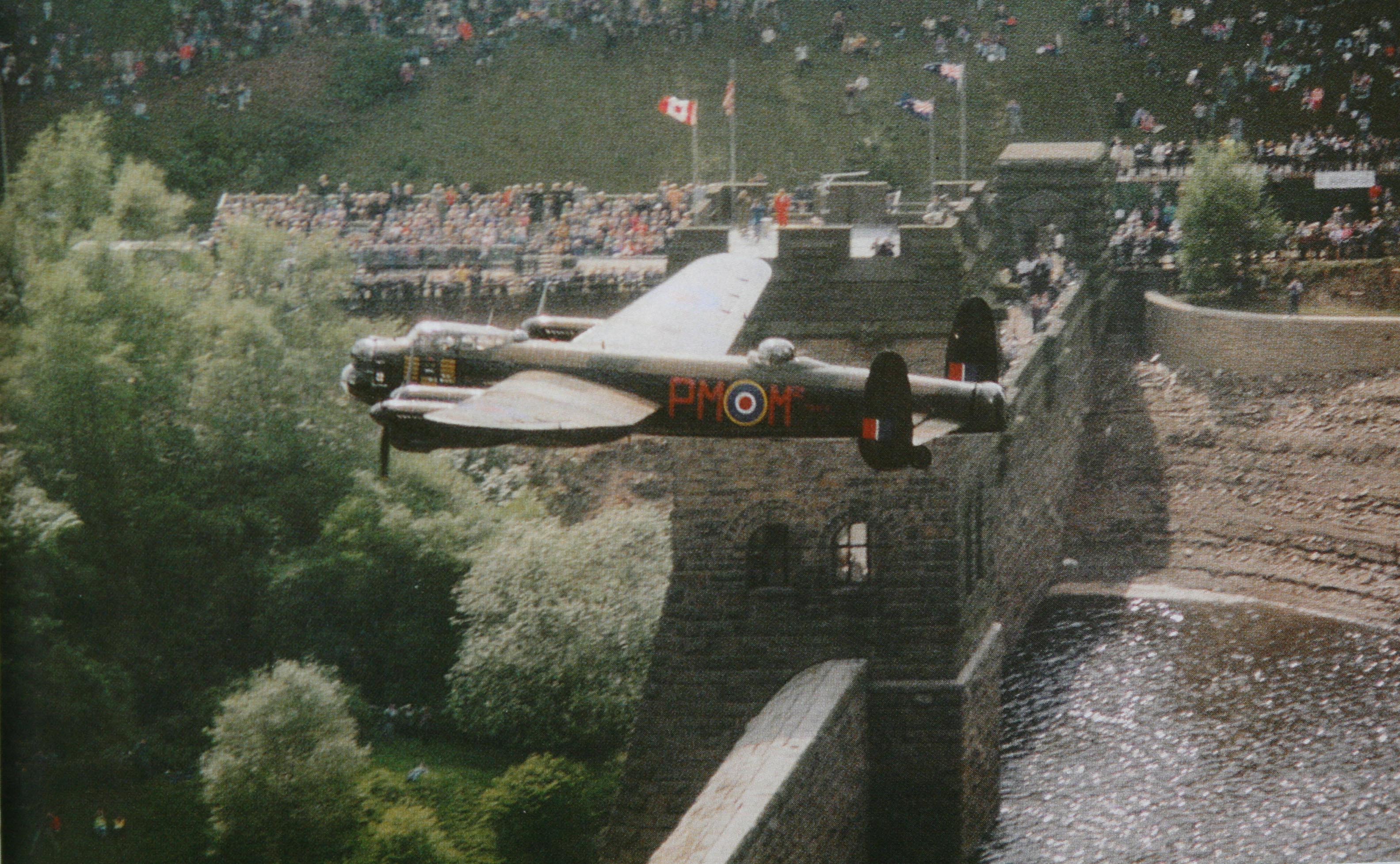
The valley is also haunted by a phantom Lancaster bomber of WW2 vintage that has regularly been seen skimming the surface of the water on moonlit nights. The Howden dam and reservoir further north were used by the RAF’s famous 617 Squadron, led by Wing Commander Guy Gibson, as target practice during the secret development of the ‘bouncing bomb’ that was used in the attack on the Mohne and Eder dams in Germany during 1943.

One of the last remaining Lancasters on a return visit to the Derwent Dam in a 1990s ceremony to commemorate the 617 ‘Dambusters’ squadron…many claim to have seen phantom wartime planes including Lancasters and Dakotas skimming the Peak District hills (photo copyright Steven Payne)

Since the mid-1980s reports began to reach local media from visitors who are convinced they have seen a prop-driven RAF Lancaster aircraft skimming low above the reservoir complex. On occasions these sightings have been so circumstantial that inquiries have been made with the operators of the single operational Lancaster, based at an aviation museum in Lincolnshire, always without result. Some witnesses have claimed the vintage plane they saw was so low they instinctively felt the urge to ‘duck’ their heads as it passed overhead. Their descriptions do not match those of the giant RAF Hercules transports that sometimes hedge-hop along the valley that I have seen on several occasions.

One couple who saw the ‘phantom bomber’ from a layby on the Ladybower reservoir on an October night in 1982 initially thought the object was a hang glider. Then a burst of moonlight revealed the distinctive outline of the wartime RAF Lancaster. Unlike a real Lancaster, however, the phantom version was uncannily silent and ‘continued flying over the reservoir…and then, quite suddenly, vanished before our eyes, leaving us stunned’.

Others have reported their sightings to the emergency services fearing the pilot had crashed into the steep hills of the Peak District. Sightings of phantom planes are well known from other locations in the UK and abroad and are often associated with a tragic loss of life but although there have been up to fifty air-crashes in the Peak since WW2 none have involved Lancasters. Since WW2 operational vintage aircraft have visited the valley regularly to take part in well-advertised anniversary fly-overs. The first of these was during the filming of the movie The Dam Busters, released in 1955 staring Richard Todd as Gibson and Michael Redgrave as Dr Barnes Wallis, the inventor of the bouncing bomb.

Is it possible more recent visits, including the one in 1993 to mark the 50th anniversary of the bombing raid, have triggered an existing folk memory to produce vivid experiences of the type reported by visitors to Ladybower?

The process whereby tradition, belief, suggestion, imagination and memory interact with objects in the landscape in an ongoing, dynamic process that produces accounts of mysterious ‘timeslips’. David Bramwell’s journey ultimately leads him to the conclusion that the most powerful force in his landscape and the most powerful forces on Earth are represented by the waters that consumed Derbyshire’s answer to Atlantis.

The Cult of Water CD is available from https://oddfellowscasino.com/ and the accompanying booklet, by David Bramwell and Pete Fowler is published by http://roughtradebooks.com/

Posted in Uncategorized | Tagged , , , , , , , , , , , , , , , , , , , , , , | 1 Comment

Away with the fairies: Cottingley photos exhibition

Five photographs of fairies dancing at the bottom of a Yorkshire garden that became ‘the world’s longest running hoax’ are the focus of a compelling new exhibition.

The story of the greatest hoax of the 20th century is told in the Cottingley fairy exhibition at the University of Leeds, Brotherton Library, that runs until 2022.

The Cottingley fairies legend began in the summer of 1917 as the Great War raged in the trenches of the Western Front. Schoolgirl Elsie Wright, 16, took a photograph of her nine-year-old cousin Frances Griffiths posing with some tiny dancing figures that she had drawn and attached to hat pins arranged around the Cottingley Beck, between Bradford and Bingley, in West Yorkshire

According to the exhibition it all began with a tall tale. One day the youngsters were scolded after they returned home from the beck with wet feet. Frances explained that she went there ‘to see the fairies’.

Her story was greeted with disbelief so the girls borrowed Elsie’s father Midg quarter plate camera, determined to provide proof. They came back with two photos, one showing Frances with the dancing fairies and a second showing Elsie with a leaping gnome.  

In the aftermath of the war the girl’s mothers shared the curious images at a meeting of Theosophy Society in Bradford. News reached one of its senior members, Edward Gardner, who was convinced they were genuine. From here the prank spiralled out of control when Gardner sent them to his friend, the Sherlock Holmes author Sir Arthur Conan Doyle.

Doyle had converted to spiritualism during the war and wanted to use the images in his ongoing battle with skeptics. He deliberately courted controversy, describing the fairy photos as ‘an epoch-making event’ when he published the first two images in The Strand magazine during 1920.

Doyle never met the young women but Gardner visited the beck and said he felt ‘energies’ there. He arranged for a photographer, Harold Snelling, to make ‘improvements’ to the photos and left Elsie and Frances with a new Kodak camera. He clearly hoped they would produce more evidence and sure enough, in the summer of 1920, the girls took three more images of fairies dancing around the beck.

The women stuck to their stories for 60 years. Interviewed by Yorkshire TV in 1975 Elsie Wright, aged 74, said: ‘I have told you that they’re figments of our imagination and that’s what I’m sticking to.’

But in 1983 Elsie and Frances, both grandmothers, confessed to the hoax when the truth was exposed in an article by Geoffrey Crawley, editor of the British Journal of Photography.

Even then Frances continued to maintain the fifth and last image, dubbed ‘the Fairy sun-bath’ was a genuine photograph of the little folk she had seen around the beck.

During the past century dozens of books, newspaper articles, TV documentaries and two Hollywood movies have been devoted to telling versions of the story. Few photographers today can look at these images and accept them as anything but fakes. The lighting of the ‘fairies’ does not match that of the young women and the figures have a flat, one-dimensional appearance because that was precisely what they were.

The iconic image of dancing fairies taken at Cottingley beck in West Yorkshire by 16 year old Elsie Wright in 1917 takes centre stage in the exhibition

But the exhibition at the Treasures of the Brotherton Gallery, University of Leeds, is the first time that many of the original artefacts from the legend have been placed on public display. It tells the story in chronological order, drawing upon correspondence from Doyle, Gardner and members of the girl’s family. Both cameras featured in the display are on loan from the National Science and Media Museum in Bradford after a public appeal saved them a Christie’s auction.

The original negatives have long since disappeared but fourth-generation copies from the batch ‘improved’ by Snelling can be scrutinised by visitors. Also on display is a copy of the Princess Mary’s Gift Book, published in 1914, that inspired Frances to draw the fairies.

The book contained Alfred Noyes’ poem A Spell for a Fairy, that was illustrated with three dancing figures. They have an unmistakeable similarity to those depicted in the Cottingley photographs. Ironically the book also contained a chapter by Sir Arthur Conan Doyle.

The exhibition was originally planned to mark the centenary of the last three photographs that show Elsie and Frances posing with individual fairies sporting distinctive 1920s hairstyles. This big giveaway did raise some suspicions in Doyle’s inner circle but he refused to believe two ‘young girls’ could hoodwink the creator of Sherlock Holmes who employed hard logic to solve riddles.

In fact Elsie was a skilled artist and worked for a few months in a photographer’s shop in Bradford where she had experience retouching photographic plates.

Following his death in 1969 Edward Gardner’s family donated his Cottingley fairy collection to the Brotherton Library. This exhibition has been curated by Dr Merrick Burrow, head of the Department of English and Creative Writing at the University of Huddersfield, who summarises the story as ‘an accidental conspiracy’.

‘There were a series of minor deceptions that in themselves would not really have amounted to anything,’ he said. ‘But these were blown up into a global cause celebre through the combination of Elsie’s skill with the camera, the “improvement” of the photos by an expert working for Gardner, and the involvement of Conan Doyle – probably the world’s foremost popular author with an interest in spiritualism’.

In the online lecture that accompanies the exhibition Dr Burrow compares elements of the story with fake news and social media bubbles in the present day. He said in one corner there was Conan Doyle and those ‘who believed without question in spiritualism’ whilst in the other were their opponents in the Rational Press Association and opponents of spiritualism.

‘Neither would give ground to the other, which is what we see now’.

The Cottingley Fairies: a study in deception runs until 17 November 2022 at the Treasures of the Brotherton Library, University of Leeds, Woodhouse Lane, Leeds LS2 9JT.

Current opening hours are Tuesday-Friday, 11am-2pm but check the website for updates:

Posted in Uncategorized | Tagged , , , , , , , , , , , , , , , | 1 Comment

The UFO that Never Was?: the Calvine photographs

Is this blurry image really the ‘most compelling evidence’ for UFOs visiting the UK?

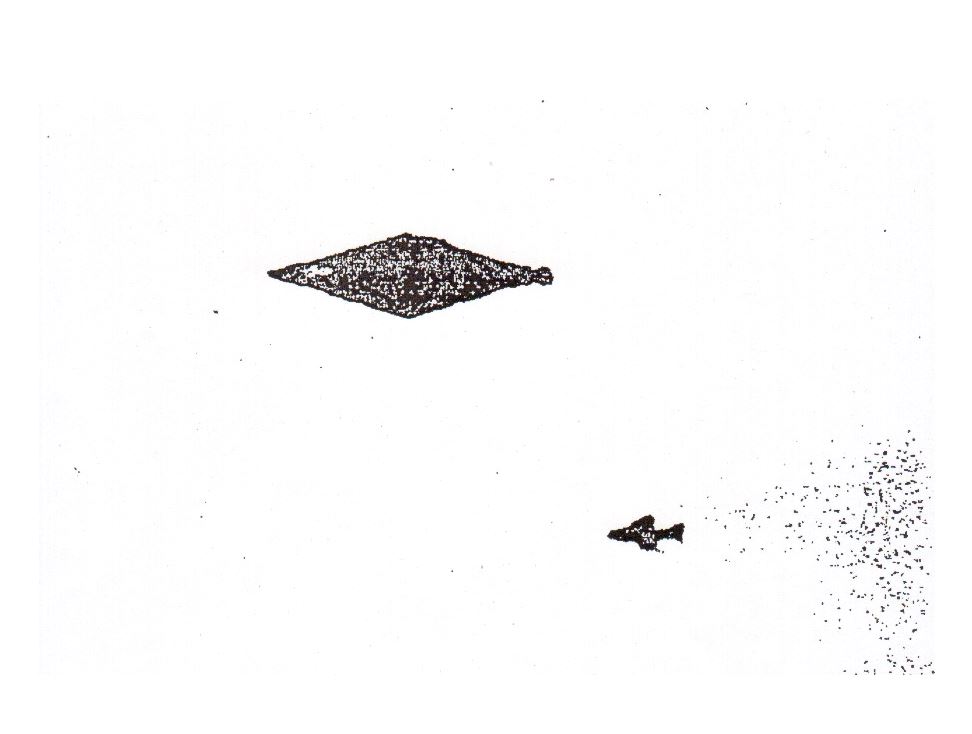
A photocopy of a line drawing showing one of the Calvine photographs (Crown Copyright)

Does it show a secret US ‘black project’ operating over Scotland?

Or are the Calvine photographs an aerial version of the Loch Ness Monster?

After a lengthy investigation, drawing upon responses to FOI requests and testimony from MoD insiders, I can provide some possible answers.

Click here to read my Calvine case file.

An aura of mystery has grown around this story because the identity of the photographer is currently being with-held by the MoD, under Data Protection laws, until 2076.

Despite the fact that he or she originally sent their negatives to a Scottish newspaper, The Daily Record, the name of the photographer remains redacted from MoD UFO files released by The National Archives in 2009. The newspaper did not publish a story and passed the images to the Ministry of Defence.

Today, more than 30 years later, it seems that first generation images, taken from the negatives, remain squirrelled away in the UK and/or US intelligence archives (or both).

Pressure from lawmakers on both sides of the Atlantic – and Freedom of Information requests – might lead to their release.

The image on the right (below) is a ‘colourised version of a blurred image’ published by the UK tabloid The Sun in October 2020, based upon a photocopy of a drawing that was released by The National Archives.

According to which version of the story you believe, the original is one of six colour photographs taken by two men walking near the A9 in the Scottish highlands one August evening in 1990.

They show a dark, wingless diamond-shaped craft accompanied by a smaller aircraft, identified as a RAF Harrier jet.

Both were seen and photographed as they buzzed a remote Scottish valley, 20 miles north of the town of Pitlochry.

What is often not mentioned in media accounts is the incident allegedly happened on Saturday 4 August 1990, just two days after Iraqi forces invaded Kuwait, triggering off the first Gulf War.

Another curious fact is the Calvine photographs were completely unknown to the public until 1996 when Nick Pope, ex-MOD desk officer turned UFO pundit, published a brief account of the sighting in his first book Open Skies Closed Minds.

In the book Pope says his Head of Division – who he does not name – believed they might show the mythical US spy-plane Aurora that was the subject of much Press speculation at the time.

Pope claimed that expert analysis had revealed that the photographs are ‘not fakes’, but neither they nor he accepted the Aurora theory. He added:

‘The Calvine report remains one of the most intriguing cases in the Ministry of Defence’s files. The conclusions, however, are depressingly familiar: object unexplained, case closed, no further action’.

Speaking to The Sun in May 2021 he went further, claiming the photos are ‘sensational’.

He added: ‘The photos are pretty much as good as it gets. They were assessed by the defence intelligence staff as real…they were clearly visible, sharp focused, broad daylight with the Scottish countryside in the background.’

According to three separate senior MoD sources and documents I obtained from responses to Freedom of Information requests, the photographs were indeed the subject of several expert investigations. These were carried out by the Defence Intelligence Staff, the RAF’s JARIC agency and by the Pentagon.

The dossier reveals how, in 1992, the DIS sent an image of a ‘possible research vehicle‘ flying in Scottish airspace to the CIA. That image was sent to the Pentagon where it was subject to further US-UK analysis, as revealed in a document written by the UK’s Air Attache in Washington DC.

Extract from letter sent by RAF Air Attache in Washington, Simon Baldwin, to Sir Donald Spiers, MoD Controller of Aircraft, on 18 December 1992 (Crown Copyright applies)

But although my sources disagree about what they images show, they all agree that whatever was captured on film was not a UFO because it was not unidentified. That might explain why a full set of papers are missing from the UFO files released at The National Archives in 2009.

A source in MoD’s defence intelligence staff, whose identity I have chosen not to reveal, claims the object in the photograph was identified as a US experimental aircraft. He says it was operating from a RAF base in Scotland and was escorted, not shadowed, by RAF and US aircraft.

If true this would contradict Parliamentary statements in 1992-93 that no authorisation had been given by the UK Government for the US to operate experimental aircraft in its airspace.

There was nothing extraterrestrial about what was seen in Scotland,’ he said. ‘No one else other than the Americans had anything like it at the time. We were not allowed to say exactly what it was. But we knew what it was.’

He claimed the US agencies ‘went ballistic’ when they saw the image, which he said had been captured by civilians in ‘a one in a million chance’.

But his story is contradicted by RAF Air Commodore Simon Baldwin, who commanded Britain’s last V-bomber squadron that saw action in the Falklands War. Baldwin was serving as Air Attache in Washington when one of the images from Scotland surfaced at the Pentagon in 1992.

When I spoke to Baldwin he dismissed the theory that the object in the photograph was a Stealth aircraft. He believes the whole story is a spoof – the same word he uses in a memo sent to MoD in December that year that I obtained using the Freedom of Information Act.

Baldwin says he was called in by a 3-star Lt General after the CIA sent one of the photographs to the Pentagon without informing them the source was UK MoD.

In the misunderstanding that followed, it emerged that the Pentagon believed the image actually depicted a RAF experimental aircraft developed using secret Stealth technology, shared with the British, without the knowledge of the US Government!

Baldwin believes the story – and the photographs – were the result of an elaborate hoax that briefly fooled the intelligence services.

He says the photographs – one of which he saw – depict ‘an airborne Loch Ness Monster’.

Baldwin’s involvement is revealed in a series of letters he sent to London whilst Air Attache during 1992, copies of which I obtained using the Freedom of Information Act. One was addressed to Sir Donald Spiers, Controller of Aircraft at MoD, a 3-star rank at the time.

The prank explanation was confirmed by Sir Donald, a former Assistant Chief Scientist RAF. He said that he recognised the black and white image from the MoD files as the same one he saw at the time. There was, he said, ‘no doubt that the photograph was a spoof,’ a conclusion he claims is based upon analysis by ‘our technical experts’.

So, who should we believe?

It seems to me that we have three options.

No 1 – the Calvine photographs show an unidentified, extraterrestrial spacecraft shadowed by RAF/US aircraft flying in broad daylight over Scotland. The UK and US intelligence agencies have covered-up the evidence for 30 years and have silenced both the photographer and the newspaper that was sent the photographs.

But if this was true the conspiracy has not been very effective.

Why if the photos were ‘above top secret’ was a poster-sized copy of one image printed out and placed on a wall in the MoD office where it could be seen by civilians such as Nick Pope? (for more details see my case file here).

Even if this was an error, why did the intelligence services then allow Pope to blow the gaffe in his book that we know was subject to security clearance before its publication?

And why did MoD agree to the the release at The National Archives of poor quality black and white photocopies of the images 13 years later?

No 2 – the ‘object’ in the photographs is a super-secret US experimental project such as the TR-3 Black Manta or the hypersonic Aurora. This is the explanation offered by my Defence Intelligence source. I am convinced he is telling the truth as he remembers it. This is not impossible but seems unlikely.

I remain unconvinced that such a project could be concealed for three decades. Also, if it is so super secret, why risk flying it in broad daylight on a weekend evening in Scotland when it could have been tested in secrecy at Area 51 or above the ocean? When I asked Nick Pope about this possibility he said ‘we know where we exercise and we know where we test’ and where you test your exotic hardware is generally over the sea at night.

Even so it remains possible the images show a UAV or some other experimental platform that was undergoing tests shortly after the outbreak of hostilities in Kuwait. Only the full release of UK and US analysis of the images – and the photographs themselves – can resolve this question.

No 3To quote Sherlock Holmes ‘once you eliminate the impossible whatever remains, no matter how improbable, must be the truth’.

Using Occam’s Razor I believe we can eliminate option 1 as fiction that belongs to a plot from The X-Files. It would be nice to believe it but the evidence simply does not stack up.

Option 2 is not impossible but remains unlikely. This leaves us with one remaining theory that makes the fewest uncorroborated assumptions. The only explanation that makes sense is the photographs are fakes. Either this was a deliberately created hoax or an opportunistic one, in that the person or persons concerned photographed a Harrier then, when the pictures were processed, found a flaw on the negative that they then tried to pass off as a UFO.

Due to the compartmentalised nature of the UK MoD this would explain why both Nick Pope and my DI source had no ‘need to know’ about the results of the UK-US analysis of the images that must have happened early in 1993 and has left no record in the released documents.

It would also explain why the photographer has not come forward, despite significant media coverage. It might also explain why the Daily Record spiked the story and why no one (including MoD at the time) has been able to trace the source of the RAF Harrier shown in the image.

If it really was a spoof then the unusual date, time and location provided in the original report to MoD might also be false. As it is a pre-digital image there would be no way of proving its precise provenance.

Interest in the Calvine photographs continues to grow as the story becomes a prototype UFO legend. The idea of a vast conspiracy to hide the truth is characteristic of how these stories grow and become part of the larger UFO mythology.

Last year I told a freelance journalist how The National Archives had removed the name of the Calvine photographer from a MoD dossier that mentions the photographs, first released in 2009.

This revelation was published by The Sun on 10 October 2020, along with the ‘colourised version’ of the image and a comment from Nick Pope, the man who first released news of the story in his 1996 book.

But the tabloid omitted any reference to the actual source of what it called ‘a complaint lodged under the Freedom of Information Act about the National Archives withholding documents’ that was ‘now under investigation by the UK information watchdog’.

It went on to claim ‘a dossier into Britain’s most significant UFO sighting is to be kept secret for another 50 years’ adding further layers to perceived cover-up.

But the redaction of the name was not ‘without explanation’ as the tabloid claimed, nor was it anything to do with a massive cover-up of the Calvine images.

The facts are that the names and addresses of all UFO witnesses and MoD officials who dealt with their reports have been routinely redacted from files transferred to The National Archives since 2005. From that date section 40 of the Freedom of Information Act, covering personal information, replaced the former ’30 year rule’. This has been further complicated by the arrival of the GDPR European legislation covering private information.

The name of the photographer is just one of hundreds, if not thousands, of other names and addresses currently being with-held from those files under the draconian Data Protection legislation, sometimes for up to 80 years.

The TNA decision to withhold the name, if upheld on appeal, will remain in force until 1 January 2076. If successful it will ensure that, unless he comes forward voluntarily, we will never learn who took the Calvine photographs in either his and our lifetime.

Only pressure from politicians and the media will resolve this mystery once and for all.

Of course it would be a better story if the Calvine photographs turn out to be genuine ‘compelling evidence’ for UFOs – or indeed, top secret military technology.

But if they were the result of a clever hoax that successfully fooled the MoD, the CIA and the UFO community, then maybe his decision to remain anonymous might be a very sensible policy!

Text copyright Dr David Clarke 2021

Posted in Uncategorized | Tagged , , , , , , , , , , , , , , , , , , , , | 3 Comments

How UFOs Conquered the World – without firing a shot

BBC History Magazine/History Extra published my article that explains how the idea of visitors in mysterious flying objects grew from its origins in the Cold War into the most enduring modern myth.

You can read the main feature here (password access required). There are links to a UFO timeline (1946-2021) and my list of the Top Ten UFO sightings from Kenneth Arnold to the USS Nimitz here.

History Xtra‘s Rachel Dinning also recorded an interview with me that can be downloaded as a podcast. The History and Mystery of UFOs, here.

International media interest in UAPs (unidentified aerial phenomena) has intensified following the release of the Pentagon’s intelligence report on UAPs (unidentified aerial phenomena) on 25 June, almost 74 years since the first modern report of ‘flying saucers’ by pilot Kenneth Arnold in 1947.

Pressure has grown after three years of news coverage that began with a story published by the New York Times in December 2017 that revealed the existence of a semi-secret Department of Defense programme that investigated UAPs.

A series of close encounters reported by US Navy pilots led the Office of Naval Intelligence to establish a UAP Task Force in August last year.

The last time the CIA convened a panel to review the best evidence for UFOs (or ‘flying saucers’) was in 1953 at the height of the Cold War.

The recommendation of the Robertson Panel was that federal agencies ‘take immediate steps to strip the Unidentified Flying Objects of the special status they have been given and the aura of mystery they have unfortunately acquired’.

And here we are 68 years later awaiting a new US intelligence report on a subject that refuses to die. Commenting upon the enduring mystery, in History Xtra I say:

‘Today, as tensions grow between the USA and its main adversaries Russian and China, how fitting that unidentified flying objects should once again become a factor in what some historians have called the Second Cold War.’

Posted in Uncategorized | Tagged , , , , , | Leave a comment

ATTACK OF THE DRONES

At 9pm on Wednesday, 19 December 2018, a security guard left work at Gatwick in Sussex, Britain’s second busiest airport. As he waited in the rain for a bus he saw two lighted objects hovering low in the sky inside the complex. He immediately called the airport control tower to report a breach of security and soon afterwards the main runway was closed to air traffic.

As police patrols combed the area clusters of further sightings were made. According to some media reports the object or objects seen was described as an ‘industrial specification’ drone. More reports poured in until 9 am on the following morning, Thursday 20 December.

By daybreak 58 flights into Gatwick had either been cancelled or diverted, five police forces were involved and the Sussex constabulary had sent up its own drones and a helicopter in search of the intruders.

According to a BBC Panorama investigation 140,000 people were caught up in the chaos that followed the airport closure. The 33-hour shutdown at Gatwick led 1,000 flights to be cancelled or delayed at an estimated cost of £50 million to airlines.

Fearing further incursions, on the afternoon of 20 December Gatwick called in special military radar systems that can jam the signal between operator and the drone.

According to new information released in response to Freedom of Information requests by the Department for Transport, further drone incursions were logged at 2.30, 7.45 and 10.30.

The very last confirmed sighting was logged at 5 pm on Friday, 21 December – almost 48 hours after the first drone ‘sighting’.

As the panic spread, there was much speculation about the identity and motives of the drone operators. Some media sources claimed airports were being targeted by terrorists or eco-activist groups for attacks using drones.

Sussex Police continue to believe that a real drone or drones were involved in the Gatwick incident. But at an early stage in their investigation doubts were expressed by one of their own senior officers, Det Chief Supt Jason Tingley, who told the BBC: ‘We cannot discount the possibility that there may have been no drone at all’.

The Gatwick case shares some similarities to the phantom helicopter scare of 1973-74 that began with a series of ‘sightings’ by security guards at quarries where explosives were stored. These convinced senior police officers in northern England the IRA were using a stolen or unregistered machine to steal explosives or for use in a jailbreak. As in the 1974 scare, the Sussex police decision to launch their own helicopter to investigate the mysterious intruder at Gatwick triggered off a spate of ‘sightings’ of the phantom drones.

Among the new drone witnesses was a Brighton-based press photographer, Eddie Mitchell, who drove to Gatwick with his cameras at the ready and two of his own drones locked in his boot. At 5pm on 20 December Eddie saw and photographed what he believed were the white, green and red lights of the drone as it hovered above Gatwick airport. But when he downloaded the images it became apparent that he had actually snapped the Sussex police’s own helicopter!

Eddie later told The Guardian ‘if I’m making a mistake – and I fly drones two or three times a week – then God help us because others will have no idea’.

But the tabloids were less concerned about the identity of the object in Eddie’s photographs. As Ian Hudson who runs the UAV Hive website explained ‘some journalists just didn’t really care if the photos they were using were a drone or not’. One of Eddie’s images continues to appear on The Sun website captioned as ‘the drones’.

Ian told me ‘the idea a couple of drones were flying around in the rain for prolonged periods’ seemed far-fetched.

He also finds it ‘beyond credible’ that not one single clear photograph or video of the intruder has emerged and ‘a number of camera operators that were at Gatwick have spoken out since on social media about their belief there was no drone’.

Even more persuasive is the evidence from the specialist counter-drone systems (known as C-UAS) installed at Gatwick airport in the hours after the first sighting. One arrived at 2.40 on 20 December and another was in place by 9pm when visual sightings were still being reported. Both were capable of detecting both the drones and their transmitter but neither recorded anything unusual.

Despite these evidential problems in April 2019 Gatwick’s chief operating officer, Chris Woodroofe, told the BBC the airport authorities had received 170 separate ‘credible drone sightings’ from 115 people including trusted staff such as security patrols and police officers. ‘They knew they’d seen a drone. I know they saw a drone,’ Woodroofe said. ‘We appropriately closed the airport’.

At the time of writing the operators have never been identified. A married couple from Crawley were arrested by Sussex Police and held in a police station for 36 hours on the basis that they owned a collection of model aircraft. They were released without charge after questioning. In June 2020 Sussex police paid the couple £200,000 in an out of court settlement. No one ever claimed responsibility for the scare or claimed the £50,000 reward offered by Gatwick for information that might lead to those responsible.

In the aftermath, the government passed new legislation to widen the exclusion zone around airports from one to five kilometres. Nationwide, police forces were given more powers to seize drones from their operators and prosecute those who break the strict regulations that prevent them from being flown in sensitive places.

Sussex Police formally closed their investigation of the incident in September 2019 after 18 months, having spent £800,000 on their inquiry, with no further ‘realistic lines of inquiry’. The force said it had ruled out a link with terrorists and there was no evidence ‘it was either state-sponsored, campaign or interest-group led’. They believe it was a ‘serious and deliberate criminal act designed to endanger airport operations and the safety of the travelling public’.

Drone experts including Ian Hudson interviewed by journalist Samira Shackle for her Guardian investigation remain unconvinced. Probing more deeply, what exactly did the witnesses at Gatwick actually see? A moving object with bright lights attached that hovered and was seen fleetingly on a rainy night in darkness. In any other context this would be classified as a sighting of a UFO. From the point of view of the airport authorities and police this must be a drone because UFOs do not exist.

But as Hudson told me, basic facts about the case don’t support this theory. ‘The first sighting was in the rain,’ he said. ‘Drones tend to fail in the rain. In fact there are few models that are capable of any kind of semi-reliable rain use’. Commercial drones also have in-built geofencing software that block them from flying near sensitive locations such as prisons, stately homes and airports.

If the operators were clever enough to hack the drone’s software and evade the regulations to fly them into Gatwick airspace, why did they allow the UAV to carry lights? ‘The normal lights on drones are low power LEDs that couldn’t be seen at a significant distance,’ he said. ‘Also drones aren’t equipped as standard with a strobing light. Any mischievous drone pilot that didn’t want to be caught wouldn’t use lights. You would turn them off in the software or tape them up’.

Hudson and fellow UAV operator Gary Mortimer filed a series of FOI requests asking Sussex police and the Department for Transport for basic information about the more evidential sightings made by police and security guards.  Hudson asked for confirmation of one description given to the media at the time that ‘the alleged Gatwick drone was industrial sized’.

But on 5 May this year the DfT admitted their records ‘do not hold any information on the description’. Hudson tells me this suggests neither the police nor the government have any clear account of what the drone actually looked like. He said the DfT had consistently hidden behind national security as a “get out clause” when quizzed about the specifics.

Mortimer briefly flirted with the idea of the scare being a cover for some other covert operation. Now he feels the actual explanation is more prosaic. He told Shackle ‘one option is that something that wasn’t a drone was reported and then the next day, police flew their [copter] there and people saw that’.

As UFO investigations have discovered time after time, ordinary objects can suddenly become extraordinary when people expect to see something unusual – or in this case threatening – in the sky. During the phantom helicopter scare of 1973-74 there was widespread anxiety about Irish terrorists and police confirmation of the sightings triggered off a visual epidemic. Today that anxiety has transferred to other terrorist groups and mysterious drone operators.

The 2018 scare was not the first cluster of mysterious aerial sightings in the vicinity of Gatwick airport. Earlier incidents were reported in 2017 and the MoD’s archived UFO files reveal how on 15 July 1991 the crew of a Britannia Airways Boeing 737 returning from Greece and descending into Gatwick at 14,000 feet saw ‘a small, black lozenge-shaped object’ zoom past at high speed 100 yards off the port side. Ground controllers confirmed a ‘primary contact’ was visible on radar 10 nautical miles behind the 737 moving at a speed estimated as 120 mph. Helium-filled toy balloons could potentially reach this height, but commercial drones cannot.

More recently a series of airprox reports from aircrew involving close shaves with ‘unknown objects’ in Gatwick airspace have been investigated by UK Airprox Board (UKAB) which is sponsored by the Civil Aviation Authority (CAA) and Military Aviation Authority (MAA). Statistics from UKAB’s log reveal a dramatic increase in reports of drones and other ‘unknown objects’ made by civilian aircrews in UK airspace from just seven in 2018 to 31 in 2019.

The log includes an incident from April 2018 that was placed in the highest collision risk category. At lunchtime on 28 April 2019 the runway at Gatwick was temporarily closed after the crew of an Airbus 319 climbing out of the airport saw an object breaking through cloud at 17,000 ft (5,200m). According to the crew ‘it passed below them from the centre of the aircraft and under the right-hand wing’ and was clearly contrasted against the clouds. The small object ‘appeared dark green in colour with a white light on top’ and may have been hovering. As a result of this close shave, three other aircraft were diverted to other airports.

Further details of recent UKAB investigations and the possible sources of the current UFO-drone epidemic are explored in my article Close Encounters of the Drone Kind in Fortean Times 406 (June 2021). Special thanks to Ian Hudson and UAV Hive for information used in this article.

Posted in Uncategorized | Tagged , , , , , , , , | Leave a comment

Rendlesham UFOs 40th anniversary: The Man from the Ministry speaks for the first time

This weekend marks the 40th anniversary of Britain’s best known UFO legend, when unidentified Christmas lights haunted the sky above Suffolk’s Rendlesham forest.

Books, TV dramas and films have portrayed the sightings reported by groups of US air force personnel who witnessed the puzzling events outside the perimeter of RAF Woodbridge over two nights in December 1980.

Simon Weeden – MoD UFO desk officer 1980-81 – pictured during the 1980s (Copyright Simon Weeden)

Until recently little was known about how the British Ministry of Defence had dealt with the incident.

When the contents of Lt Col Charles Halt’s now famous memo were broken by The News of the World in 1983 the MoD said his report had been passed to ‘staff responsible for the air defence of the UK’ who had decided it was ‘of no defence significance’.

In 2001 the MoD agreed to release their file on the case to me after I used Freedom of Information legislation to apply for access.

But the ‘Rendlesham file’ was mainly a collection of correspondence with members of the public years after the incident itself. It did, however, contain original documents from 1981 that I used to piece together what happened in the corridors of Whitehall.

Now the former MoD civil servant who received Col Halt’s report and worked with RAF experts to establish the facts has agreed to explain exactly how their decision was reached.

Simon Weeden joined the MoD as a junior civil servant after the general election of 1979 when Margaret Thatcher won power for the Conservative party. As a graduate entrant he was assigned to defence secretariat DS8 – the MoD branch responsible for UFOs – in the following year.

Dealing with UFO correspondence was a tiny part of his duties and his department had no resources or remit to investigate hundreds of sightings that reached the ‘UFO desk’, mainly from members of the public. He said:

‘Our role was primarily dealing with correspondence from ministers and members of the public…We didn’t investigate but acted as fact-finders, consulting with experts in areas like radar and air defence.’

Then early in January 1981 an unusual report arrived on Simon’s desk. The subject matter was ‘Unexplained Lights’ and it was signed by Lt Col Charles Halt, USAF deputy base commander at RAF Woodbridge.

Halt described how on 27 December a US security patrol had reported seeing a triangular object in the forest after responding to reports of an unusual lights outside the back gate of the NATO complex.

The following day Halt’s report said unusual marks were found at the ‘landing site’ on the ground and in the trees. Col Halt reported having supervised a second night-time expedition into the forest. On this occasion unusual radiation readings were detected at the ‘landing’ site and Col Halt and his men saw a ‘red sun-like light’ moving through the trees.

Halt’s dramatic account was accompanied by a covering letter signed by Squadron Leader Donald Moreland, the British liaison officer. He forwarded the account of ‘mysterious sightings in the Rendlesham forest near RAF Woodbridge…for your information and action as considered necessary’.

Squadron Leader Donald Moreland, RAF Woodbridge’s British base commander, who liaised with the USAF (Copyright David Clarke)

Weeden said that Moreland’s note, dated 15 January – 18 days after the sightings – was the first time MoD was notified of the sensational events.

‘Nearly always the reports we got were from ordinary members of the public,’ Simon said.

‘This one was very unusual in that it came from a military source within our organisation. It is the only one of its kind that I can remember from my time working on UFOs for DS8.’

His first action was to circulate Halt’s report to the specialist branches that he relied upon for guidance on what action, if any, was required.

Among these was a RAF air defence branch, Ops GE, whose experts monitored UK airspace using real-time data from radar stations that defended the East Coast. These were the front line in the ongoing Cold War with the Soviet Union at that time.

In the days that followed RAF Squadron Leader Jack Badcock checked Halt’s report with the joint CAA-military Eastern Radar at RAF Watton, near Thetford and with the RAF sector radar HQ at RAF Neatishead in Norfolk.

‘The MOD priority at the time was to establish if this was something that had an air defence aspect…Should we be concerned about this? Did it come up on radar? Did anyone notice anything odd…bearing in mind that the radars at Neatishead and Watton were manned 24 hours every day by skilled radar operators.’

But none of the radar stations checked reported anything unusual on their logs over the Christmas holidays. If there had been an air defence alert, RAF Ops would have known about it.

‘Aircraft were scrambled on a routine basis,’ Simon added. ‘If something is out over the North Sea and you don’t know what it is, it’s not responding, you would send up a Phantom or Lightning to have a look and see what it was.

‘But once we had been through all the basic checks and found there was nothing seen on radar, no obvious explanation, no obvious threat to air defence, we decided no further action was needed.’

How The News of the World broke the story in its famous pg1 splash of October 1983 (Credit: Ian Ridpath)

Simon did recall talking to his RAF colleagues about other potential explanations. US Air Force night time manoeuvres, people such as poachers moving around in the woods at night with lamps ‘that sort of thing’ were considered.

‘This was quite a flat part of the world and maybe these were lights from quite far away that were shining through the trees,’ he said, referring to the theory – championed by skeptic Ian Ridpath – that the airmen saw the flashing beacon from the Orfordness lighthouse 6-7 miles away.

But the MoD did not investigate UFOs and even though Badcock was told Col Halt had made a tape recording of his adventure in the forest, it was decided not to ask for a copy because it would ‘reveal no better report than that already received’.

Weeden also copied Halt’s report on radiation anomalies to desk officers in the Defence Intelligence staff who had resources to follow-up if required. But although DI55 said they could not explain Halt’s report they decided not to investigate further.

‘Our interest was never in unidentified flying objects as potential spaceships,’ he explained. ‘Unidentified flying objects are exactly that. They are unidentified. They might have lots of natural explanations but we would not put any effort into investigating, to try and sort out exactly what it was once the initial assessment had decided we didn’t need to worry about it’.

Simon Weeden left the MOD many years ago and this event is not uppermost in his mind but, despite the lack of concern at the time, he does not dismiss the UFO phenomenon. After leaving the MoD in 1988 he trained as a clergyman and spent the next 30 years in parish ministry. 

‘People do have extraordinary experiences,’ he told me. ‘That’s a fact. So I would never poo-poo those people who say to me they have had things like near-death experiences or felt some kind of angelic presence at times of crisis.

Simon Weeden: final word (copyright: David Clarke)

‘I do believe that people have experiences that can’t be explained. But they can be interpreted in a number of different ways. The interpretation depends upon what your viewpoint or standpoint is. If people have a propensity for conspiracy theories or alien manifestations they will interpret them through that filter.’

And Simon’s final word on the Rendlesham Forest UFO mystery 40 years after the events?

‘I think this is obviously something that exercises people’s imaginations. People want to know what the explanation is. I suspect that at the end of it all the explanation is probably going to turn out to be something quite mundane. But I can’t say that definitively; because I just don’t know.

The 40th anniversary of Britain’s best known UFO legend has also been marked by a BBC News feature here. The article includes quotes from John Burroughs, whose book Weaponisation of an Unidentified Aerial Phenomena, was published earlier this month. John served in the US Air Force for 27 years and was one of the three man patrol that was sent to investigate what was first thought to be a plane crash in the forest beyond the RAF Woodbridge perimeter.

BBC reporter Nic Rigby also interviewed forester Vince Thurkettle who lived in the Rendlesham forest at the time and who was visited by two mysterious men who arrived at the Forestry Commission office late in December and asked if anyone had reported strange lights in the vicinity of the USAF complex.

Vince believes they may have been British officials who had heard rumours about the UFO incident. But it is more likely they were local journalists who had been tipped off by the Suffolk police who had responded to call from RAF Woodbridge in the early hours of Boxing Day morning.

One of the first civilian investigators to begin inquiries into the UFO mystery is Jenny Randles, author of the first book on the legend, Skycrash (1986) and UFO Crash Landing (1998).

Earlier this month I interviewed Jenny along with John Burroughs for a special extended 40th anniversary edition podcast UFO-LORE. Jenny had not spoken to John since 1988 when they last met at UFO conference in Arizona.

The free-flowing discussion that follows touches on many of the more puzzling aspects of the mystery that continues to fascinate and engage people across the world so long after the original events.

You can listen to the podcast on SoundCloud here or visit our Facebook page for more information here. UFO-LORE is also available from iTunes and Spotify.

Posted in Uncategorized | Tagged , , , , , , , , , , , , , | 4 Comments